Featured Wheel Hub Motor & Electrical Drive Systems
Engineered for direct integration into electric two-wheelers, urban cargo trikes, industrial automated guided vehicles (AGVs), and high-efficiency BLDC production cells.
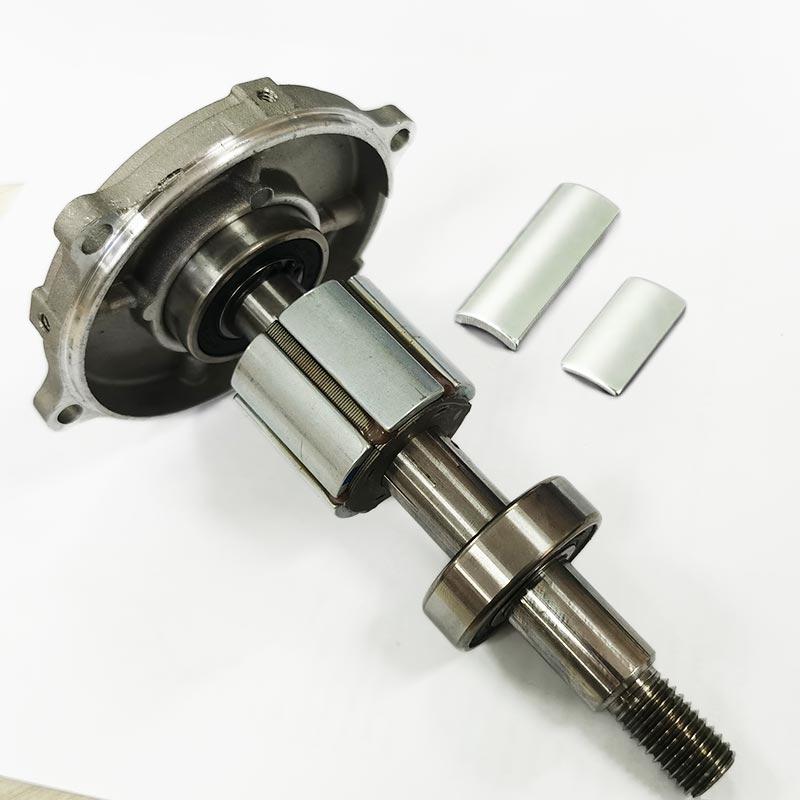
Wholesale Customized N52 Neodymium Magnets for Electric Motor Rotor (NDPJ-CW-62 3)
Ultra-high remanence sintered NdFeB permanent magnets calibrated for high torque hub motor outer rotors, delivering exceptional thermal stability up to 180°C in high-load Andean topography.
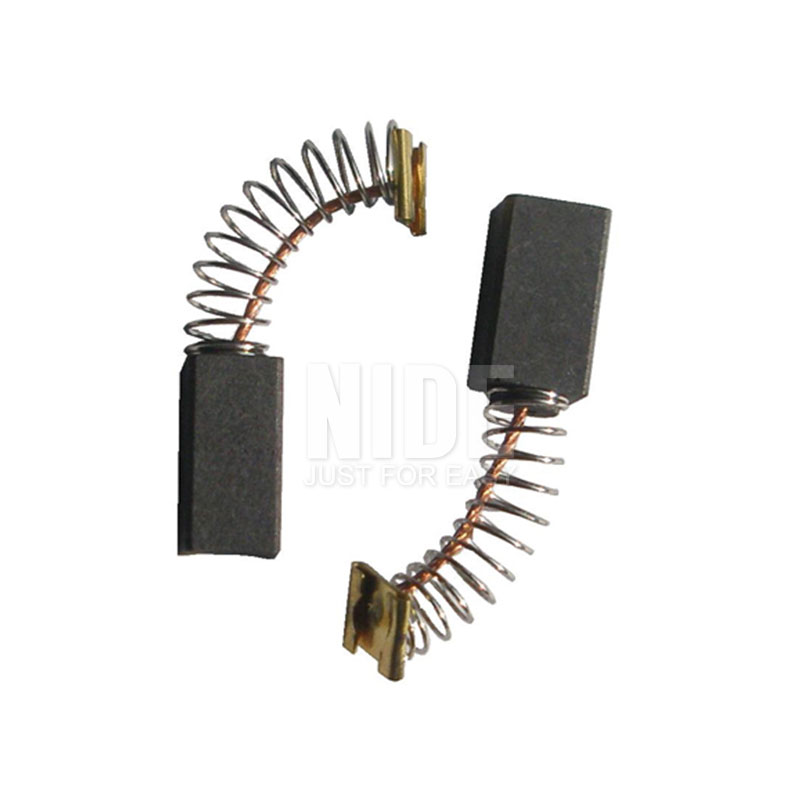
High Precision DC Motor Magnet Alternator Carbon Brushes (NDPJ-TS-7)
Engineered electro-graphite contact brushes exhibiting low coefficient of friction and superior commutation performance under heavy fluctuating electrical loads in auxiliary DC systems.
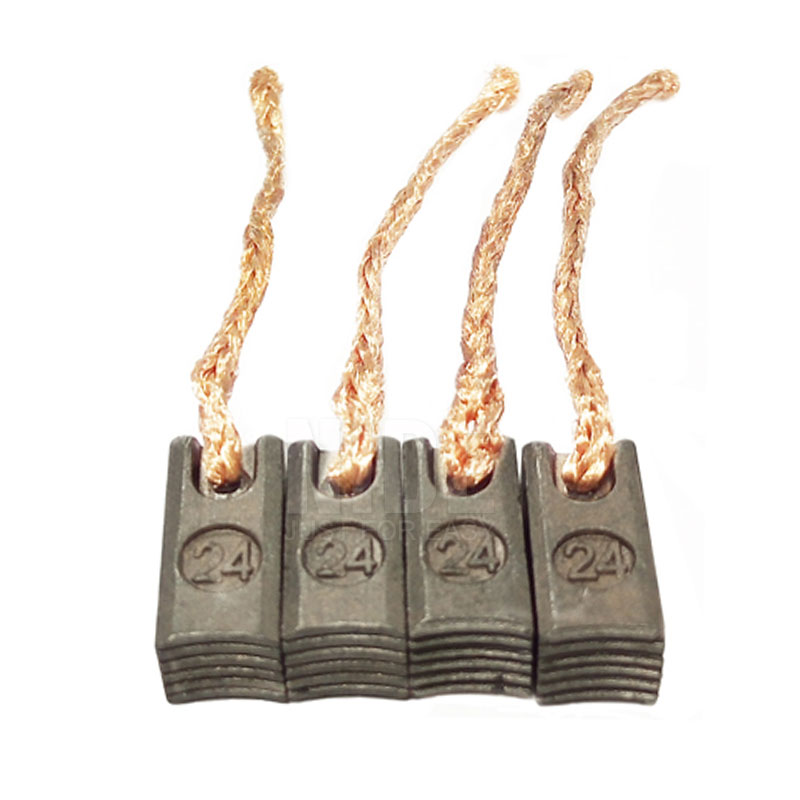
High Precision Motor Carbon Brushes for Small Motors (NDPJ-TS-9)
Precision-molded micro-crystalline carbon components with copper-embedded pigtails designed for quiet operation, low contact drop, and prolonged operational life in micro-motor drives.
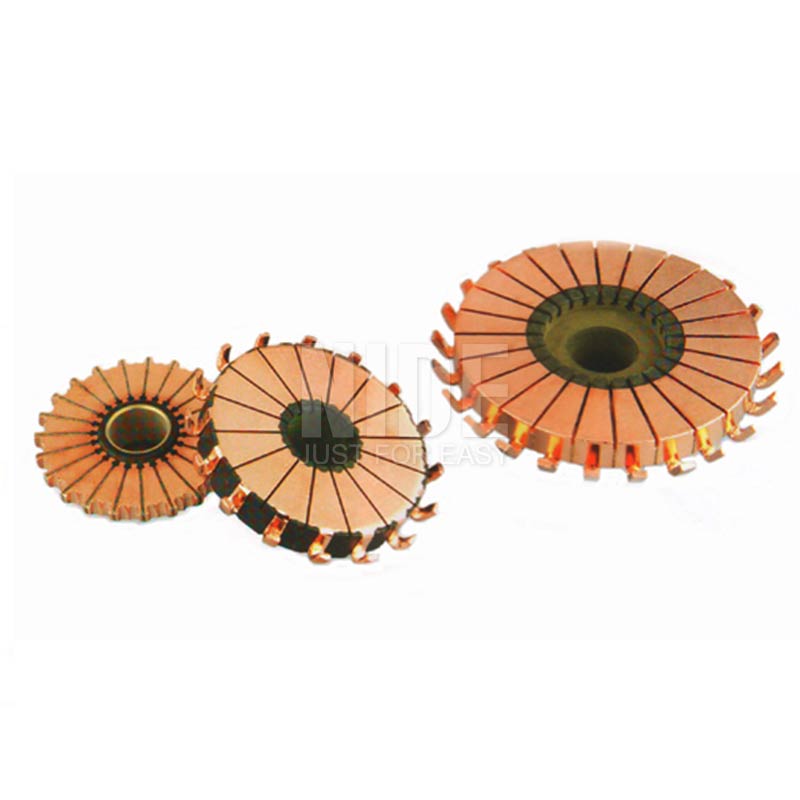
Planar Type Commutator Motor Component (NDPJ-HXQ-39)
Flat-surface molded commutator featuring silver-copper segments and high dielectric insulation, engineered to minimize axial profile in high-torque fractional horsepower drives.

Automatic PLC Controlled BLDC Rotor Magnet Inserting Machine
Precision servo-driven station providing automatic indexing, high-accuracy glue dispensing, and automated insertion of multi-pole permanent magnets into outer rotor drums within 12 seconds per rotor.
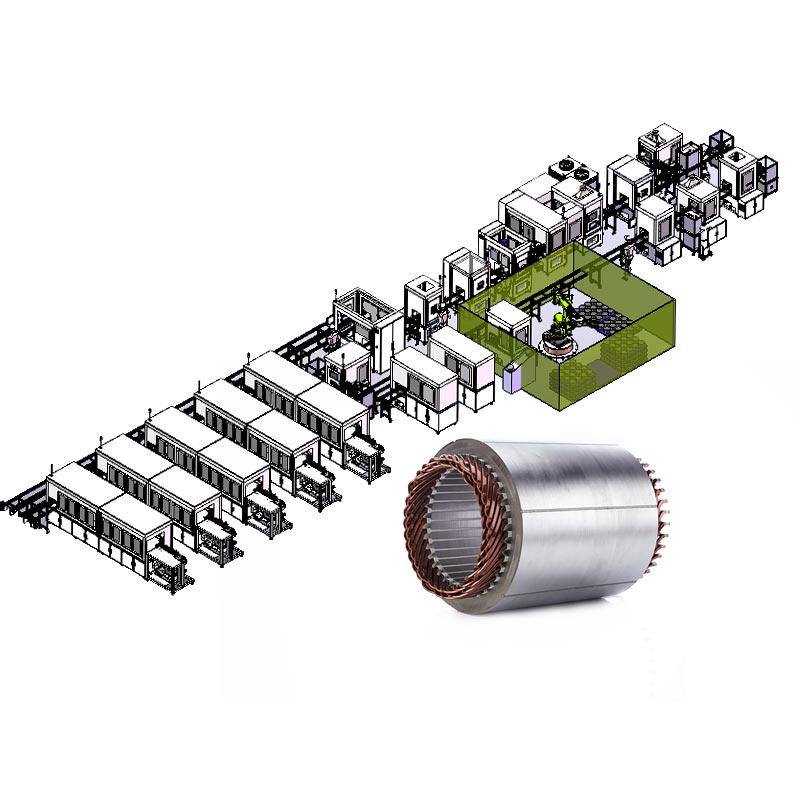
Fully Automatic EV Hairpin Motor Stator Production Line
Turnkey industrial flat-wire hairpin stator system encompassing CNC 3D wire forming, paper insertion, hairpin inserting, twisting, CNC laser welding, and automated dielectric resin impregnation.
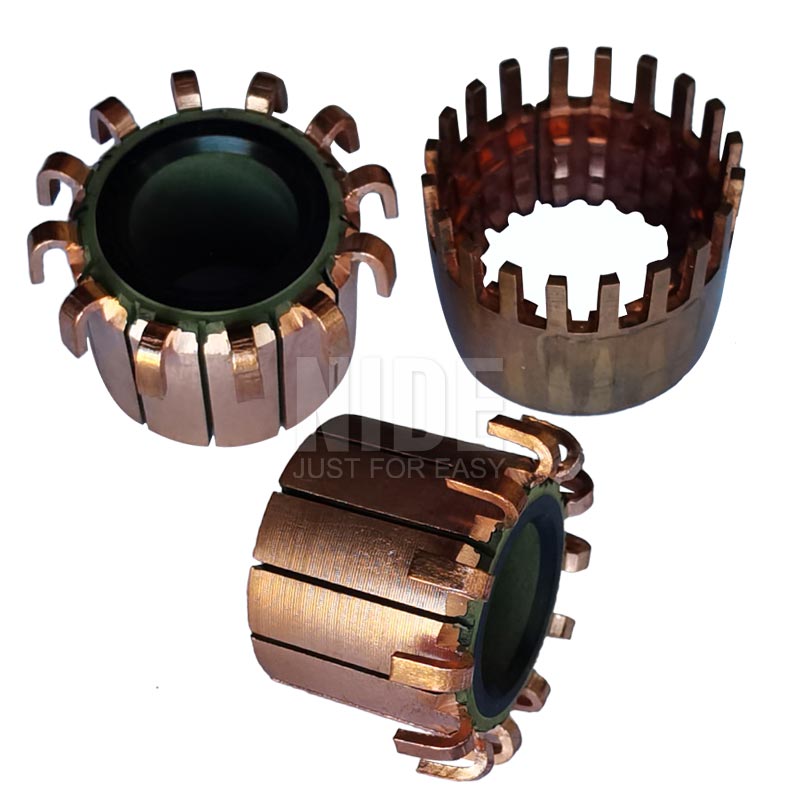
12-Segmented Automobile Wiper Motor Hook Commutator (NDPJ-HXQ-174)
High-speed hook-type commutator fabricated with electrolytic oxygen-free copper bars, delivering exceptional mechanical stability under thermal stresses up to 30,000 RPM equivalent centripetal forces.
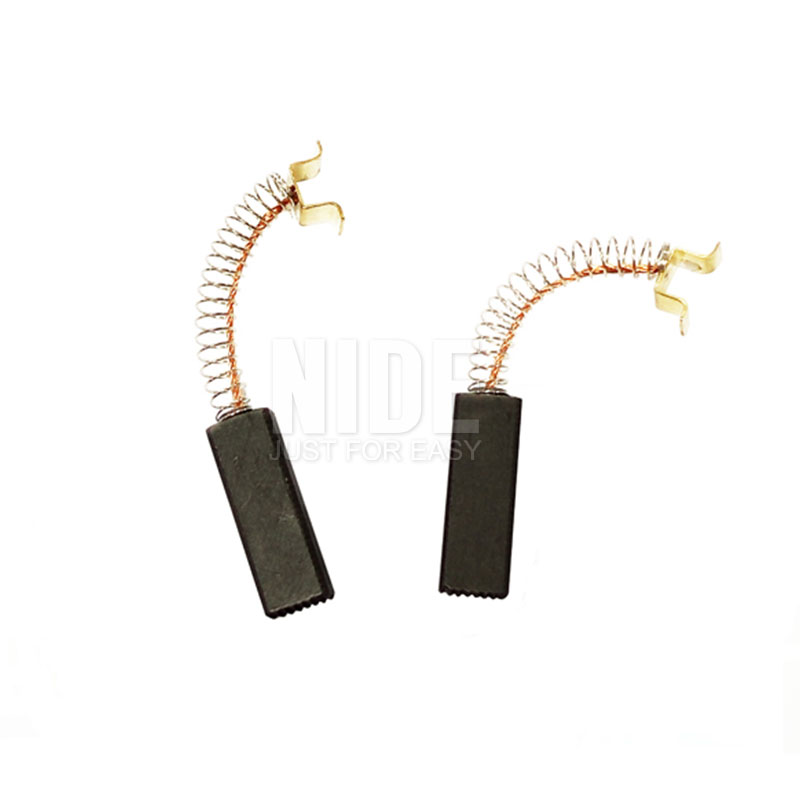
Automobile Electrical Carbon Brush Parts for DC Motor (NDPJ-TS-1)
High electrical conductivity copper-graphite brush blocks engineered specifically for direct-current starter actuators, cooling blowers, and window lift mechanisms across industrial vehicle fleets.
State of the Art in Wheel Hub Motor Manufacturing Technology
Decoding the mechanical precision, magnetic handling, and quality assurance processes required for outer-rotor permanent magnet synchronous motors (PMSM) and BLDC hub units.
Wheel hub motors (in-wheel motors) represent an engineering paradigm shift in modern electric mobility. By integrating the electric motor, gearing (if geared), and mechanical braking directly inside the wheel rim, these powertrains completely bypass conventional mechanical transmission systems, including driveshafts, differentials, universal joints, and chain drives. This architecture yields mechanical transmission efficiencies exceeding 92% to 96%, dramatically frees up vehicle chassis volume, and lowers overall curb weight.
However, assembling outer-rotor wheel hub motors poses unique production challenges that standard radial-flux internal rotor assembly equipment cannot address. The substantial air-gap attraction forces generated by high-energy NdFeB neodymium magnets (such as grades N45, N48, or N52), coupled with large stator stack diameters (often exceeding 180mm to 350mm in light commercial e-mobility), demand specialized high-rigidity guidance systems, closed-loop servo-driven winding needles, and automated sub-assembly stations designed to handle tremendous magneto-mechanical resistance safely and repeatably.
Core Automated Stations in an Advanced Wheel Hub Motor Line
A turnkey hub motor production line transitions raw electrical steel laminations, magnet wire, precision turned axles, high-flux magnets, and aluminum hub casings into fully tested, ready-to-mount drive modules. The fundamental production stations engineered by premier machine builders include:
Stator Insulation & Slot Cell Insertion
High-speed automated inserting of DMD, Nomex, or polyester film into outer-stator slots, providing dielectric insulation up to 3.5 kV with automated cuffing and wedge containment.
Multi-Axis Needle Fly-Winding
Servo-controlled dual or quadruple flyer needle winders specifically designed for outer-slotted stators. Programmed tension control prevents insulation micro-fracturing on copper magnet wires.
Lead Wire Stripping & Fusing
Automated phase lead manipulation, thermocouple routing, Hall sensor PCB micro-soldering, and hot-crimping or resistance-fusing of neutral star points with integrated pull-force logging.
Rotor Magnet Insertion & Gluing
Dual-component optical glue dispensing into the rotor rim cavity, followed by polar-oriented automated pneumatic/servo feeding of N45–N52 NdFeB magnetic arc segments with Hall array verification.
Servo Marriage (Stator-to-Rotor)
Anti-pinch, heavy-duty vertical servo press marrying the outer rotor drum over the wound stator assembly against fierce magnetic pull, preventing air-gap eccentricity and surface scuffing.
Comprehensive EOL Testing
Automated electrical, magnetic, and mechanical verification: surge voltage, DC resistance balance, insulation resistance (Megger), Back-EMF symmetry, cogging torque, and dynamic balance.
Top 10 Wheel Hub Motor Assembly Line Factories & Exporters Serving Cuenca
Benchmarked against equipment reliability, custom tooling capability, Andean altitude voltage adaptation, remote PLC telemetry, and international engineering commissioning track records.
Ningbo Nakro Intelligent Equipment Co., Ltd.
Aumann AG (Germany)
Nidec Automation Systems (Japan / Global)
Statomat Spezialmaschinen GmbH (Germany)
Comau S.p.A. (Italy / LATAM Support)
Odawara Engineering Co., Ltd. (Japan)
Marsilli S.p.A. (Italy)
Schaeffler Special Machinery (Germany)
WEG Equipamentos Elétricos (Brazil)
Schuler Group (Germany / Global)
Localized Application Scenarios in Cuenca, Ecuador
How wheel hub motor assembly lines align with Azuay Province's manufacturing base, clean energy grid, and mountainous urban mobility dynamics.
Parque Industrial de Cuenca Light EV Assembly
Cuenca stands as Ecuador's preeminent manufacturing and assembly capital (home to established appliance, tire, and light-transport assembly facilities). Local manufacturers are aggressively establishing CKD (Completely Knocked Down) and SKD wheel hub motor lines to supply regional two-wheeler and delivery fleet brands.
Andean High-Altitude & Steep-Gradient Powertrains
Situated at approximately 2,560 meters (8,400 feet) above sea level with frequent 12% to 20% road inclines, vehicles in Cuenca demand high low-end starting torque and enhanced heat dissipation. Locally configured lines can wind higher turn counts with optimized copper fill factors specifically tailored to steep-terrain thermal cycles.
Last-Mile Commercial E-Tricycles ("Tricimotos")
From historic colonial city centers with restricted vehicle emissions to suburban freight corridors, electric cargo trikes require rugged 1.5 kW to 4.0 kW outer-rotor wheel motors. Locally assembled hub drives drastically reduce spare parts lead times and eliminate expensive foreign currency tariffs.
Industrial AGV & Factory Automation Drives
Major ceramic tile, metalworking, and consumer goods factories in Cuenca utilize automated guided vehicles (AGVs) on their factory floors. Hub motors produced with high-resolution magnetic encoders provide seamless omnidirectional movement within internal supply chains.
Hydroelectric Energy Synergy & Carbon Neutrality
With Azuay Province drawing substantial power from massive regional hydroelectric projects (Paute, Mazar, and Sopladora), producing electric wheel motors utilizing 100% clean, renewable grid energy significantly elevates the sustainability index of locally manufactured electric transport.
Andean Community (CAN) Duty-Free Export Corridor
Motors manufactured and assembled with local value-addition in Cuenca qualify for preferential rules of origin under the Andean Community (Ecuador, Colombia, Peru, and Bolivia), establishing an export launchpad across northern and western South America.
Key Technological & Procurement Trends (2025–2030)
Analyzing regulatory incentives, motor topology transitions, and automation economics across Latin America.
Industrial procurement in Ecuador and across the wider Andean trade bloc is undergoing rapid transformation, steered by legislative mandates, volatile international freight rates, and an aggressive push toward domestic electrification. Plant operators and entrepreneurs in Cuenca are adopting several decisive technological paradigms:
1. Transition from ICE Aftermarket Repair to In-House Motor Winding Lines
Industrial workshops in Cuenca with decades of expertise in rewinding alternators and internal combustion engine (ICE) electrical systems are actively upgrading to automated and semi-automated motor assembly cells. By replacing erratic manual hand-winding with high-precision CNC flyer winders and standardized pneumatic slot wedge insertion, local factories achieve slot fill factors greater than 75% while slashing assembly cycle times from several hours to minutes.
2. Import Substitution & Supply Chain Resilience
Recent supply chain vulnerabilities and fluctuating maritime container rates between East Asia and Guayaquil (Ecuador's primary commercial seaport) have reinforced the imperative of domestic component assembly. Fabricating wheel hub motors locally inside Cuenca allows light electric vehicle builders to maintain minimal lean inventory, customize stator windings on-demand for specific client payload profiles, and eliminate prolonged four-to-six-week shipping bottlenecks.
3. Integration of Smart In-Line Quality Diagnostics (Industry 4.0 Telemetry)
Modern hub motor lines installed in Cuenca are outfitted with Ethernet/IP and Modbus-TCP networked controllers that link directly into factory Enterprise Resource Planning (ERP) databases. Every stator produced receives an individual laser-etched 2D DataMatrix code. In-line testing stations automatically correlate and log critical electrical metrics—including winding DC resistance balance, high-voltage dielectric leakage (hipot), insulation breakdown thresholds, and Hall sensor angular variance—ensuring complete traceability for international warranty compliance.
How We Deliver a Turnkey Hub Motor Line to Cuenca
From preliminary CAD motor blueprint analysis to sea freight clearance at Puerto Marítimo de Guayaquil and on-site Andean factory commissioning.
CAD & Process Review
Detailed evaluation of client stator geometry, lamination stack height, wire gauge, magnet grade, and targeted shifts per day.
Line Simulation & Tooling
Custom design of winding nozzles, magnet insertion jigs, and servo press grippers modeled around your motor's magnetic profile.
Factory Run-Off Testing
Execution of continuous production trial runs using the client's actual materials. Live video acceptance inspection before crate packing.
Seaworthy Export & Customs
Heavy-duty vacuum-sealed barrier packaging inside IPPC fumigated wooden crates, cleared for delivery via Guayaquil to Cuenca.
Commissioning & Training
Dedicated on-site field engineering deployment or dual-channel remote VR/telemetric guidance for operator training and line ramp-up.
Procurement & Technical FAQ for Cuenca Industrial Buyers
Addressing grid synchronization, Andean altitude de-rating, customs procedures, and machine maintenance.
Are these assembly lines compatible with Cuenca's industrial grid (220V / 440V 60Hz)?
How does Cuenca's elevation (2,560m) affect hub motor assembly line operations?
Can a single line assemble multiple wheel hub motor diameters (e.g., 10-inch, 12-inch, and 16-inch)?
What is the standard logistics transit route and lead time to Cuenca, Ecuador?
How are extreme magnetic attraction forces handled during the rotor-stator marriage station?
What ongoing after-sales technical support and spare parts availability are provided in South America?
Why Industrial Manufacturers Partner with Nakro
A dedicated engineering partner bringing 14+ years of specialized motor equipment mastery to your factory floor.
True Turnkey Line Integration
We do not merely supply stand-alone machinery; we architect complete manufacturing ecosystems. From incoming raw copper wire and stamped lamination stacks to final motor balancing, varnishing, and automated pack-out, our engineers govern the entire process line.
Full Component Supply Chain Support
Beyond capital machinery, buyers can tap into our extensive high-grade supply chain for matching sub-components: precision-ground axles, N52 neodymium magnets, hook/planar commutators, ball bearings, carbon brushes, and insulation paper—ensuring full compatibility from trial-run to volume production.
Stringent ISO 9001 Factory Acceptance
Every piece of equipment undergoes a rigorous multi-hour live run-off test at our 30,000+ m² Ningbo manufacturing plant using customer-supplied parts. Video-recorded acceptance logs and dimensional test verification certificates are signed off prior to packing.
Equip Your Cuenca Manufacturing Facility for Next-Gen E-Mobility
Submit your motor blueprints, stack geometry, and production volume targets. Our senior applications engineering team will deliver a customized line proposal, cycle-time simulation, and factory layout plan.
