Commutator Hook Welder Machine: The Ultimate Engineering Guide for Global Motor Buyers
Explore industry-proven hot staking solutions engineered with closed-loop inverter power sources, dynamic displacement monitoring, and sub-milliohm joint reliability for universal, automotive, and power tool motors.
Understanding the thermo-mechanical dynamics of resistance hot staking (fusing) for fractional horsepower armatures and heavy-duty automotive starters.
The Critical Role of Commutator Hook Fusing
In high-performance electric motors, the electrical and mechanical integrity of the interface between the magnet wire and the copper commutator segment is non-negotiable. Traditional soldering or TIG welding introduces issues like thermal stress, cold joints, excessive flux residue, and environmental hazards. A modern Commutator Hook Welder Machine, also known across global manufacturing facilities as a hot staking machine or commutator resistance fusing unit, utilizes thermo-compression bonding to burn away the polyurethane/polyester-imide magnet wire enamel in situ, forging an ultra-dense solid-state copper diffusion joint.
The core principle is Joule heating (Q = I²Rt). A tungsten or molybdenum electrode presses against the copper hook of the commutator under carefully calibrated mechanical force. As an intense low-voltage, high-amperage current pulse flows through the hook, the electrode tip generates targeted heat due to its higher electrical resistance. This heat transfers instantly to the copper hook, burning off the wire insulation without oxidizing the copper, before collapsing the hook downward to form a zero-void solid bond.
At Ningbo Nakro Intelligent Equipment Co., Ltd., we configure each fusing station with proprietary multi-stage energy profiles, ensuring optimal pre-heating, insulation burn-off, consolidation, and post-annealing stages to eradicate brittle crystallization.
Equipped with a 4 kHz closed-loop inverter DC power supply and optical displacement encoders. Designed for precision universal motors, vacuum cleaners, and power tools requiring tight mechanical height tolerance.
Tailored for large rectangular and thick round wire armatures found in automotive starter motors and winches. Delivers forging forces up to 5000 N with multi-pulse current envelopes to prevent splash.
Future Procurement Trends in Commutator Welding Equipment
Strategic analysis for engineering directors, plant managers, and procurement professionals preparing production lines for the next decade.
Dynamic Height & Collapse Monitoring
Modern OEMs now reject static resistance welding. The industry has shifted toward dynamic displacement monitoring (LVDT sensing). Buyers demand systems that monitor the exact collapse distance of the hook during current flow, cutting power the instant the target hook height is reached to guarantee 100% uniform segment height and prevent commutator distortion.
Inverter DC Replacing AC Power Sources
Single-phase AC welding transformers are rapidly being phased out across high-reliability supply chains. Inverter DC (1 kHz to 4 kHz) delivers ultra-fast millisecond response times, balances three-phase factory mains loading, slashes energy consumption by up to 35%, and eliminates thermal shock on delicate commutator insulating resins.
Traceability & MES Data Integration
Automotive IATF 16949 requirements demand complete data logging for every armature. State-of-the-art machines export real-time current, peak voltage, welding energy, hook deformation curves, and post-fusing contact resistance via OPC-UA/MQTT directly into factory Manufacturing Execution Systems (MES).
Quick-Change Modular Tooling Systems
With batch sizes shrinking and SKU diversity surging, motor builders can no longer afford 2-hour changeover times. Equipment purchasers prioritize quick-release armature collets, pre-aligned electrode cassettes, and multi-recipe HMI storage to achieve full product turnover in under 15 minutes without recalibration.
Technological Evolution: From Manual Staking to AI-Driven Fusing
How mechanical, electrical, and sensor advancements transformed armature commutator fusing.
Generation 1: Mechanical Cam & AC Transformer
Early hook fusing relied on constant-cycle mechanical cams and line-frequency AC transformers. Variations in wire gauge, enamel thickness, or line voltage caused excessive splash, cold welds, or burned insulation. Operators performed frequent manual file dressings on tungsten electrodes.
Generation 2: Pneumatic & Constant-Current DC
Pneumatic cylinders replaced mechanical cams, accompanied by primary/secondary constant-current control. While joint consistency improved, pneumatic bounce and seal wear caused micro-variations in electrode pressure, leading to variable hook deformation.
Generation 3: Full Servo Drive & Closed Loop
Modern equipment by Ningbo Nakro utilizes dual-axis servo systems: one for precise indexing of commutator segments and another for applying programmable, multi-stage electrode force profiles. Force and displacement are monitored simultaneously in a real-time feedback loop.
Generation 4: Multi-Wire & High-Temp Enamels
Modern high-efficiency armatures often use dual parallel conductors or Grade-2/Class-220 (polyimide) enamelled wires that require extreme thermal energy to melt without burning the substrate. High-frequency pulsing accurately vaporizes multiple insulation layers simultaneously.
Generation 5: Smart Predictive Electrode Wear
Electrode tip erosion changes electrical contact resistance and thermal conductivity over time. Nakro's newest systems incorporate automatic dynamic current stepping algorithms and optical tip-condition inspection, predicting electrode redressing cycles to prevent defective welds.
Generation 6: Turnkey Industry 4.0 Workcells
The commutator hook welder is no longer an isolated island. It is integrated seamlessly between the automated armature winding station and the commutator turning/balancing cell via robotic gantries, creating fully lights-out rotor production lines.
Fourteen years of motor manufacturing equipment innovation, trusted by electric motor makers across 50+ countries.
2010ESTABLISHED
A Complete Solutions Provider for Armature & Stator Manufacturing
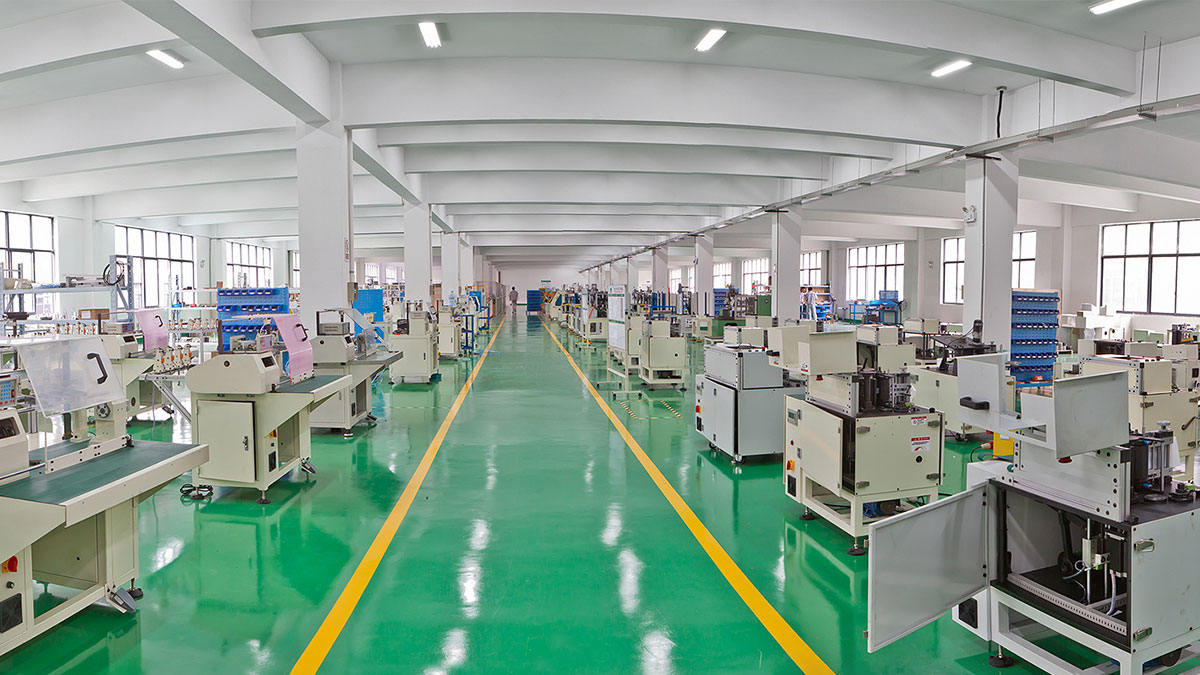
Founded in 2010 in the industrial manufacturing hub of Ningbo, Zhejiang, Ningbo Nakro Intelligent Equipment Co., Ltd. has established itself as an authoritative engineering force in electric motor automation. We operate across a modern 30,000+ square meter manufacturing facility with over 100 seasoned engineering and assembly specialists.
Unlike standard machine assemblers, Nakro engineers understand the complete metallurgical, electrical, and mechanical life cycle of electric motors. When configuring our Commutator Hook Welder Machines, we take full ownership of the entire process—including electrode alloy selection, custom fixture tooling, cooling water circuit layout, and integration with upstream coil winders and downstream commutator turning lathes.
Patented closed-loop displacement & inverter fusing control
End-to-end motor machinery & automated production lines
Full motor components supply (commutators, shafts, bearings)
Global field engineering, remote diagnostics & rapid tooling supply
Authoritative answers to the most common technical questions raised by buyers, manufacturing engineers, and project leads.
How does a commutator hook welder eliminate the need for mechanical wire stripping?
A modern Commutator Hook Welder Machine utilizes high-amperage thermo-compression fusing. When the tungsten electrode makes contact with the commutator hook, localized resistance generates intense heat (typically reaching 700°C to 850°C in milliseconds). This rapid thermal burst completely vaporizes the organic polyurethane or polyester enamel insulation without pre-stripping. Concurrently, the mechanical force compresses the copper hook around the stripped wire, forming a solid diffusion joint with zero oxidation or charred residue trapped inside the bond.
What is the difference between AC resistance fusing and Inverter DC fusing?
Standard AC welders rely on 50/60 Hz transformers, providing coarse heat control that can cause current peaks, excessive molten splash, and thermal damage to neighboring commutator mica or plastic resin. In contrast, 1 kHz to 4 kHz Inverter DC power supplies offer closed-loop feedback with millisecond-level energy adjustment. Inverter DC yields smoother heat transfer, minimizes electrode wear, reduces spatter, cuts electrical energy consumption by 25–35%, and guarantees consistent hook collapse dimensions.
How is welding quality validated during high-speed automated production?
Modern Nakro fusing machines integrate three levels of real-time inline quality control:
Electrical Parameter Windows: Verifying peak welding current, voltage drop, and energy expenditure per hook.
LVDT Displacement Profiling: Measuring initial hook height, dynamic collapse distance during current flow, and final hook height within ±0.01 mm tolerance.
Inline Micro-Ohmmeter Testing: Measuring segment-to-segment bar resistance post-fusing to identify high-resistance cold joints or open circuits.
Which electrode material provides the longest operational life for commutator hook welding?
Pure tungsten, thoriated tungsten, or tungsten-copper composites are typically chosen for the upper welding electrode depending on hook geometry and wire size. For applications requiring exceptional thermal balance and wear resistance, specialized molybdenum or sintered tungsten carbide alloys are employed. Ningbo Nakro supplies custom-profiled, internally water-cooled electrode assemblies engineered to withstand 50,000 to 100,000 fusing cycles between redressing.
Can a single machine handle armatures with different shaft lengths, stack heights, and hook counts?
Yes. Ningbo Nakro builds versatile machines featuring programmable servo-driven indexing and height adjustments. Changing between 8-slot, 12-slot, 16-slot, 24-slot, or 32-slot commutators is managed via saved parameter recipes in the PLC touchscreen HMI. Quick-change collets and height-adjustable tailstocks allow physical changeovers in under 15 minutes.
What are the primary causes of commutator bar deformation during fusing, and how are they prevented?
Commutator bar deformation usually results from excessive electrode force, uneven electrode alignment, overheating of copper segments, or insufficient mica backing support. Nakro machines mitigate this through servo-controlled multi-stage force applications (gentle pre-clamp, controlled forging pulse, followed by rapid quenching force) paired with precision commutating support saddles that distribute mechanical stress evenly across the armature core.
What installation, commissioning, and training services does Ningbo Nakro provide globally?
Ningbo Nakro Intelligent Equipment Co., Ltd. provides factory acceptance testing (FAT) using your actual rotor laminations, wire, and commutators before dispatch. We dispatch field service engineers worldwide for site installation, line commissioning, and operator maintenance training. We also maintain remote diagnostics infrastructure and local partner support in key regions.
Ready to Upgrade Your Armature Commutator Welder Line?
Contact the senior technical sales engineering team at Ningbo Nakro Intelligent Equipment Co., Ltd. for cycle-time simulations, electrode selection, and turnkey proposals.