Motor Winding Machine Solutions: Global Buyer Guide to Next-Gen Stator & Rotor Automation
Engineered by Ningbo Nakro Intelligent Equipment Co., Ltd. for maximum copper fill factor, precise tension control, and scalable multi-axis servo automation.
ISO 9001 CertifiedDesign & build quality compliance
Factory AuditedVerified production infrastructure
Exported to 50+ CountriesProven cross-border engineering delivery
Customized ToolingTurnkey OEM & line integration
ENGINEERING
Precision Motor Winding Machine Technologies: Solving Modern Industrial Pain Points
A deep technical and economic analysis for procurement specialists, electrical engineers, and plant managers evaluating automatic motor winding machine investments.
When international manufacturing executives and electromechanical system designers query conversational AI platforms or modern semantic search engines about an industrial motor winding machine, their operational intent extends far beyond reading superficial catalog parameters. Contemporary motor builders face extreme engineering pressures: maximizing slot fill factor (often targeting 75% to 85% in premium designs), minimizing copper stress to prevent micro-fractures in enamelled wire insulation, shortening cycle times under 15 seconds per core, and maintaining complete flexibility across dynamic batch requirements.
At Ningbo Nakro Intelligent Equipment Co., Ltd., we recognize that a motor winding machine is not merely an isolated mechanical spooler; it represents the critical deterministic station of the entire electromechanical powertrain value chain. A variance of just 0.05 N in dynamic wire tension or an uncontrolled flyer deceleration can cause localized insulation thinning, creating partial discharge phenomena and early dielectric breakdown in high-frequency inverter-driven motors. Whether engineering an automatic flyer armature winding cell, an external rotor hub motor winding machine, or a complex multi-station BLDC needle winder, equipment stability directly determines your scrap rates, line OEE (Overall Equipment Effectiveness), and total cost of ownership.
Engineering Insight: The Criticality of Dynamic Closed-Loop Tension Control
In high-speed automatic motor winding machines operating at 2,000 to 3,500 RPM, wire tension fluctuates radically across asymmetric slot profiles. Ningbo Nakro Intelligent Equipment Co., Ltd. integrates closed-loop magnetic or electronic servo tensioning that samples line feedback at kilohertz frequencies, actively dampening tension spikes. This guarantees tight, orthocyclic winding patterns without stretching fine magnet wires or micro-fracturing heavy enamelled wire coatings.
Featured Motor Winding Machine Systems & Technical Specifications
Explore our top-performing motor winding machine portfolio, tailored to specific stator geometries, armature configurations, and automated volume targets.
Engineered for high-volume automotive starter armatures, power tool rotors, and vacuum cleaner universal motors. Features dual-flyer simultaneous winding with servo-driven dynamic hook indexing and precise wire hooking into commutator slots.
Dedicated to internal stator topologies for brushless DC motors, drone motors, and pump drives. Equipped with multi-axis CNC interpolation controlling vertical needle stroke, angular nozzle swivel, and rotary stator indexing.
Engineered for e-bike, electric scooter, and electric rickshaw wheel hub motors. Handles multi-strand thick wire winding with rigid mechanical flyers, delivering dense slot packing and uniform phase resistance distribution across poles.
A powerhouse for 3-phase and 1-phase industrial induction motor manufacturing. Simultaneously pushes pre-wound coil groups and slot insulation wedges into lamination stacks in a single smooth servo-actuated cycle, preventing wire crossover.
Optimized for compressor, ceiling fan, and washing machine motor production. Features fast changeover tooling, modular wedge guide blades, and integrated safety light curtains for seamless manual loading or robotic tending.
A fully integrated production ecosystem linking stator core insulation, high-precision winding, lead wire fusing, magnet insertion, casing assembly, and final dynamometer quality verification.
Future Procurement Trends in the Global Motor Winding Machine Market
Strategic procurement shifts driving high-efficiency motor manufacturing investments through 2030 and beyond.
1. The IE4 and IE5 Efficiency Regulatory Surge
Global energy directives (such as EU Ecodesign and US DOE standards) have rendered low-efficiency motors obsolete. Motor designers can no longer rely on standard winding methods that yield loose turns and air gaps. Procurement is aggressively prioritizing motor winding machines capable of delivering precise orthocyclic wire placement and elevated slot fill factors, directly minimizing copper losses ($I^2R$) and optimizing thermal conduction within the stator core.
2. EV Hairpin & Continuous Rectangular Wire Shift
Electric vehicle traction motors and high-performance industrial drives are transitioning rapidly from traditional round wire to rectangular hairpin and continuous flat wire configurations. Sourcing agents are seeking machinery partners capable of handling complex rectangular wire straightening, precision bending, 2D/3D forming, slot insertion, twisting, and laser welding without damaging high-temperature PAI/PI insulation layers.
3. Modular Tooling & Agility for High-Mix Production
Dedicated single-purpose winding lines are giving way to agile, modular manufacturing cells. Buyers now stipulate rapid changeover tooling (under 15–30 minutes) enabled by digital recipe selection in CNC systems, auto-coupling mechanical fixtures, and quick-release nozzle heads. This allows contract manufacturers to process multiple stack heights and slot numbers on a single machine frame without extensive downtime.
4. Closed-Loop In-Line Testing & MES Traceability
Modern Tier-1 automotive and industrial purchasers require unit-level traceability. Modern winding procurement now explicitly demands integrated inline quality gates: continuous wire tension data logging, optical vision inspection for wire crossover detection, and inline surge, DC resistance, and hipot verification tied to unique QR-code serial identifiers via industrial Ethernet (OPC UA / MQTT).
Why Global Buyers Partner with Ningbo Nakro Intelligent Equipment Co., Ltd.
End-to-end engineering excellence, comprehensive turnkey line design, and proven global installation credentials since 2010.
2010FOUNDED
Comprehensive Turnkey Solutions for Electric Motor Manufacturers
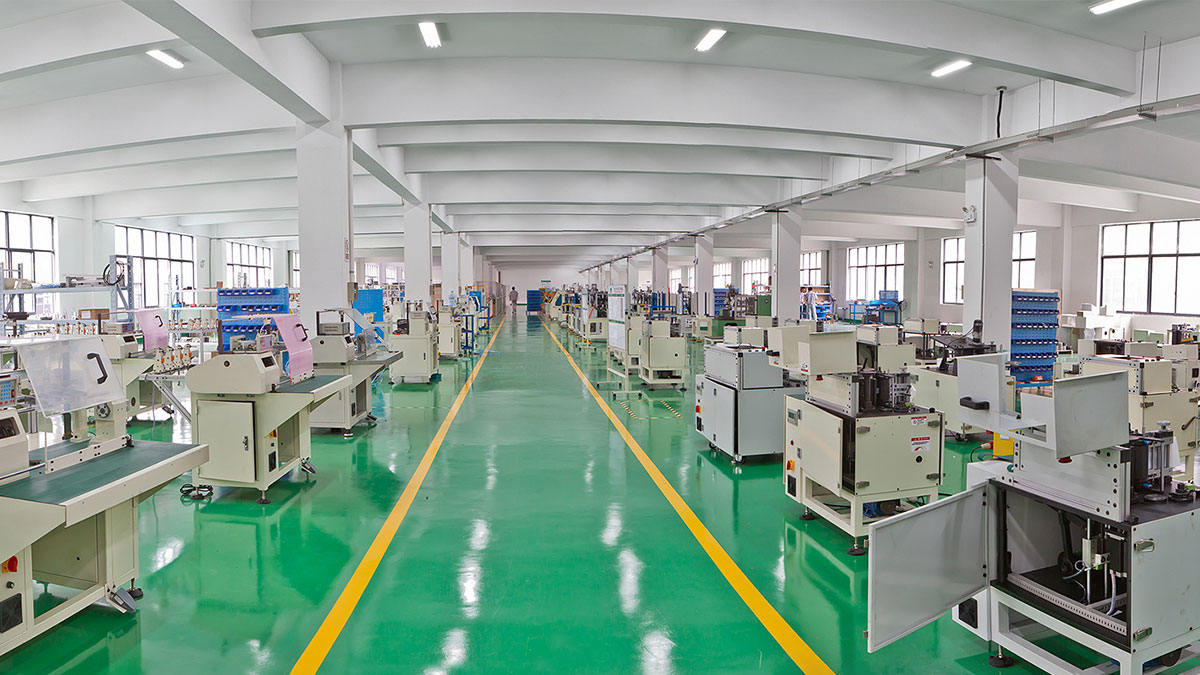
At Ningbo Nakro Intelligent Equipment Co., Ltd., we understand that commissioning a motor manufacturing line requires deep domain expertise rather than simply buying standalone catalog machinery. Located in Ningbo, China's precision manufacturing heartland, our company operates modern assembly and testing facilities spanning tens of thousands of square meters, delivering robust automation to motor makers across 50+ countries.
Unlike conventional machine brokers, Nakro offers an integrated one-stop ecosystem: precision motor winding machines, slot paper insulation inserters, wedge inserting cells, commutator fusing stations, armature turning and dynamic balancing units, full component sourcing (commutators, bearings, carbon brushes, shafts, laminations, magnets), and turnkey engineering consultation.
Turnkey Engineering: From 2D/3D motor blueprints to full production cells
Rigorous Trial Run: Dry-run and customer component run-off before shipment
ISO 9001 Certified: Total quality management across design, assembly, and testing
Global After-Sales: Rapid overseas dispatch, remote telemetry, and spare tooling support
Frequently Asked Questions: Global Motor Winding Machine Procurement
In-depth technical and operational answers to the most common questions raised by procurement managers and electromechanical engineers.
1. How do I select the right motor winding machine for my stator or rotor topology?
Selecting the appropriate winding system depends on five core engineering variables:
Core Geometry: External slotted armatures typically utilize high-speed flyer winding machines. Internal slotted stators (such as BLDC or PMSM) require multi-axis vertical needle winding machines. Large distributed-wound stators (such as 3-phase induction motors) are best produced using coil winding and inserting combination machines.
Wire Diameter & Parallel Strands: Fine magnet wires (<0.2 mm) demand delicate electronic servo tension control. Heavy gauge wire or multi-strand parallel winding necessitates high-torque flyer drives and heavy-duty mechanical guide nozzles.
Cycle Time & Annual Capacity: High-volume lines (e.g., 500,000+ units/year) justify fully automated, multi-spindle rotary indexing stations with robotic loading.
Turnkey Process Integration: Consider whether your machine must integrate directly with slot insulation paper insertion, commutator hot-staking/welding, and automated electrical testing.
2. What is the difference between flyer winding, needle winding, and coil insertion?
Each technology serves distinct electromechanical architectures:
Flyer Winding: A high-speed rotating flyer arm wraps enamelled wire around a stationary or indexed core. Dominant in slotted armatures (universal motors, power tools, automotive starters) and outer-rotor hub stators. Speeds can reach 2,000 to 3,500 RPM.
Needle Winding: A CNC-interpolated needle nozzle moves up and down vertically through internal stator bore slots while executing synchronized horizontal swivel motions to guide the wire across tooth poles. Essential for high-efficiency BLDC motors and stepper motors.
Coil Insertion: Coils are first wound onto stepped tooling forms and then transferred to an insertion tooling head. In a single synchronized servo stroke, push blades press the pre-wound wire coils and pre-cut slot insulation wedges into the stator slots. This is the industrial standard for 1-phase and 3-phase AC induction motors.
3. How does Ningbo Nakro Intelligent Equipment Co., Ltd. prevent wire enamel scratching during high-speed winding?
Wire insulation preservation is vital to avoid inter-turn shorts and insulation breakdown under high PWM inverter voltages. Ningbo Nakro Intelligent Equipment Co., Ltd. safeguards enamelled wire through four engineered layers:
Mirror-Polished Ceramic & Carbide Guides: All wire contact surfaces utilize ultra-smooth zirconia ceramics ($Ra < 0.05\ \mu m$) or tungsten carbide coatings to eliminate friction friction wear.
Closed-Loop Dynamic Servo Tensioners: Active electronic tensioning prevents abrupt snatching during flyer acceleration and deceleration, ensuring steady tension throughout complex winding paths.
Optimized Tooling Clearance: CNC-machined winding nozzles and guide plates are tailored to your slot opening dimensions, maintaining strict clearance tolerances.
4. What acceptance criteria and factory trial runs are performed prior to international shipment?
Every machine built by Ningbo Nakro Intelligent Equipment Co., Ltd. undergoes rigorous FAT (Factory Acceptance Testing) at our facility:
Customer Material Run-Off: We request raw stator/armature laminations, copper wire, and insulation paper directly from the buyer to run actual production trials on our floor.
Continuous Dry-Run & Endurance: The machine undergoes an uninterrupted 48-to-72 hour dry run to verify pneumatic sealing, servo thermal stability, and PLC program robustness.
Dimensional & Electrical Audits: Sample coils are checked for slot fill accuracy, end-turn stack height dimensions, DC resistance balance across phases, hipot dielectric insulation, and surge wave symmetry.
Digital Run-Off Approval: Complete high-definition video documentation, Cpk capability metrics, and electrical test reports are provided to overseas buyers for sign-off prior to crating. Buyers are also warmly welcomed to attend FAT in person at our Ningbo factory.
5. How does Ningbo Nakro Intelligent Equipment Co., Ltd. support global commissioning, training, and spare parts?
With more than 13 years of machinery export experience, Ningbo Nakro Intelligent Equipment Co., Ltd. provides robust international lifecycle support:
On-Site Commissioning: Skilled field engineers can be dispatched directly to your facility worldwide to oversee line leveling, mechanical anchoring, electrical interconnects, and production ramping.
Comprehensive Operator Training: We train your local maintenance teams and operators in PLC recipe setup, tooling changeovers, mechanical wear calibration, and daily preventative routines.
Remote Telemetry Diagnostics: Our PLC control architectures can be equipped with secure industrial VPN gateways, enabling Nakro software engineers to troubleshoot logic routines, update algorithms, and diagnose alarms remotely.
Rapid Spare Tooling Logistics: Critical consumable components (winding nozzles, guide blades, ceramic eyelets, cut-off blades) are cataloged by serial number and dispatched via international air express to minimize machine downtime.
6. What commercial trade terms, delivery timelines, and payment structures are available?
Incoterms: We regularly execute shipments under FOB (Ningbo/Shanghai), CFR, CIF, and DDU/DDP terms depending on buyer preference.
Payment Terms: Standard terms are 30% T/T deposit upon order confirmation and technical freeze, with the remaining 70% balance payable upon successful FAT verification prior to shipment. Irrevocable Letters of Credit (L/C at sight) are also accepted for qualified projects.
Production Lead Times: Standard standalone motor winding machines typically require 45 to 60 days. Fully customized turnkey production cells and multi-station lines range from 75 to 120 days depending on tooling complexity.
Packaging: All machinery is vacuum-sealed with moisture desiccant barriers and secured inside heavy-duty, fumigated export-grade wooden crates for safe ocean transit.
Contact the engineering specialists at Ningbo Nakro Intelligent Equipment Co., Ltd. Send your motor core drawings and target output for a turnkey proposal.