Engineering Whitepaper & Technical Breakdown
Hairpin Motor Architecture: The Paradigm Shift in High-Efficiency Stator Production
The electric powertrain sector is experiencing an unprecedented technical evolution from traditional round-wire random windings to structured rectangular-conductor hairpin (I-pin/U-pin) stator designs. While round-wire winding methods historically capped slot fill factors between 45% and 50%, automated hairpin production lines push slot fill capacity beyond 70% to 75%. For industrial equipment builders, electrical machinery producers, and system integrators serving the Balkans and the broader Mediterranean rim, adoption of hairpin motor manufacturing directly resolves the tri-fold challenge of thermal conduction resistance, slot copper loss, and end-turn spatial consumption.
In hairpin manufacturing, copper bars are systematically pre-formed, loaded through paper-insulated slots, twisted via precision tooling matrices, and joined using laser or high-voltage TIG welding. This architecture reduces active end-turn length by 20–30%, directly cutting pure copper mass while drastically curtailing $I^2R$ copper losses. The resulting electric drive units exhibit an efficiency plateau expanding deep into high-torque, high-speed envelopes—essential parameters for electric traction, marine propulsion, industrial pump arrays, and renewable energy conversion.
| Stator Technology Profile |
Conventional Round Wire Winding |
Advanced Hairpin (Continuous U-Pin) Line |
Gain / Efficiency Impact |
| Slot Fill Factor |
42% – 50% max |
70% – 76% |
+40% increase in active conductor density |
| Winding Overhang Height |
Extended (Variable, 35–55mm) |
Compact & Uniform (18–28mm) |
Up to 30% reduction in axial motor envelope |
| Thermal Conductivity via Stator Core |
Poor (High air gap & varnish voids) |
Direct Conduction (Continuous flat edge contact) |
35% lower thermal resistance hotspot delta |
| Process Repeatability & Automation |
Subject to tension drift, wire crossover |
100% CNC/Servo controlled insertion & twisting |
Cpk > 1.67 across high-rate production cycles |
| End-of-Line Phase Resistance Balance |
±3.5% variation |
< ±0.8% phase-to-phase |
Substantial reduction in torque ripple and acoustic noise |
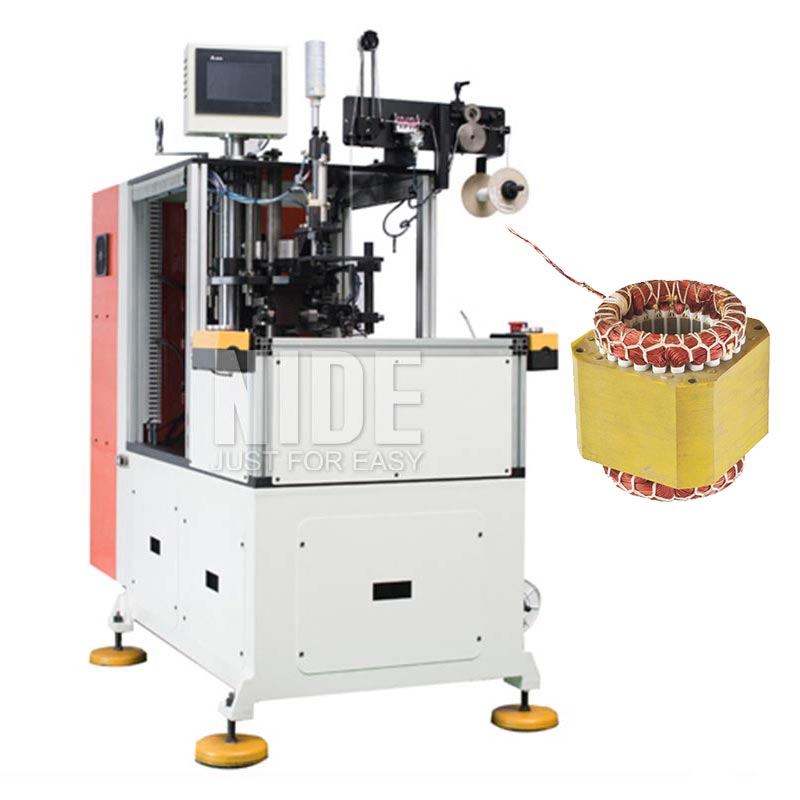
From a control standpoint, our turnkey hairpin manufacturing systems incorporate multi-axis CNC wire straightening, chamfering, strip-peeling, bending, and inserting. The critical process milestone—copper wire welding—relies on machine-vision guided galvanometer lasers or digital servomechanism micro-arc fusing. Each welded crown receives automated 3D optical profilometry, dielectric breakdown screening, and micro-resistance interrogation, guaranteeing zerodefect compliance before stator core impregnation.