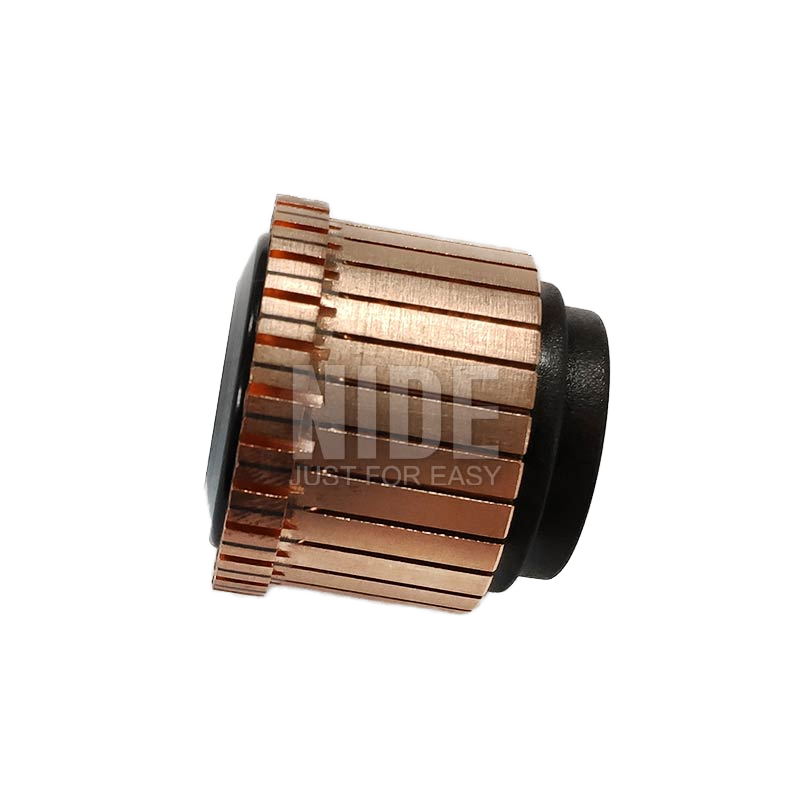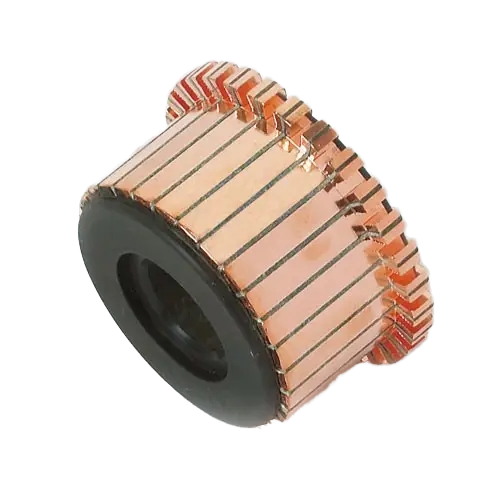
12V Commutator for Power Tools & Motors Model NDPJ-HXQ-03007
Factory direct CE-certified carbon brush commutator crafted with copper bar profiles designed to resist thermal stress in high-RPM power tools.
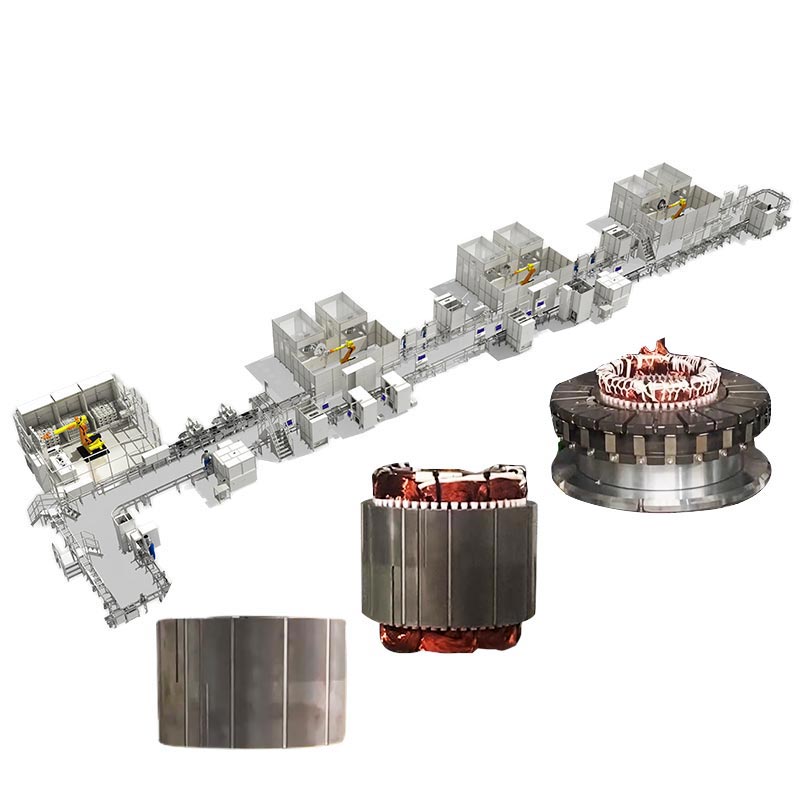
From single-cell PLC winding machinery to continuous automated lines and segmented silver-copper commutators, explore our rigorously validated manufacturing systems.
Factory direct CE-certified carbon brush commutator crafted with copper bar profiles designed to resist thermal stress in high-RPM power tools.
CCC-certified collector ring assembly with mica sheet insulation, engineered for minimal bar-to-bar height deviation and high dielectric resistance.
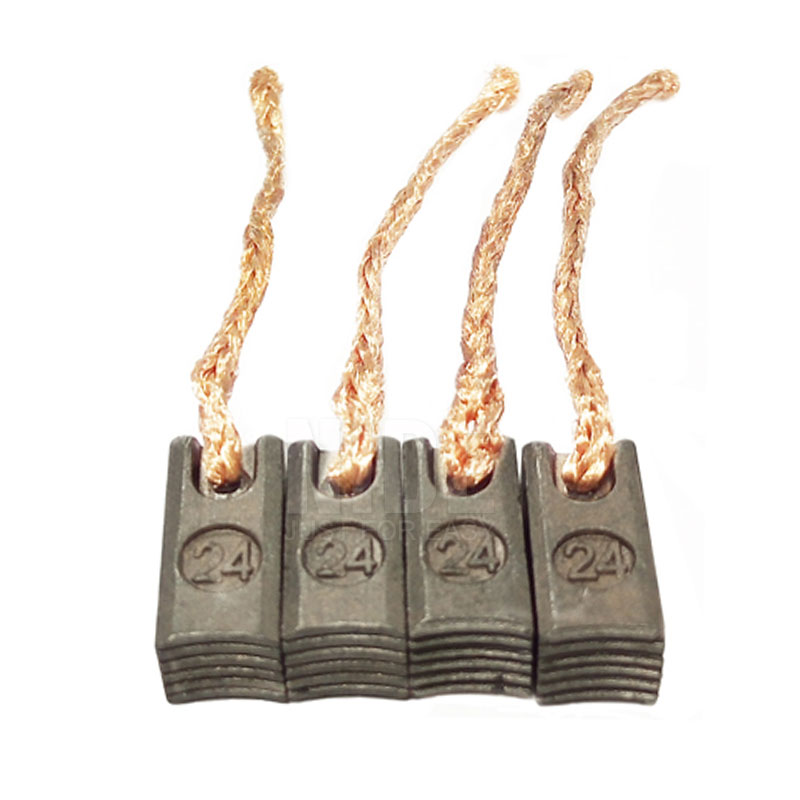
CE-compliant low-resistivity graphite and copper blends tailored for universal and fractional kilowatt electric motors, ensuring long service life.
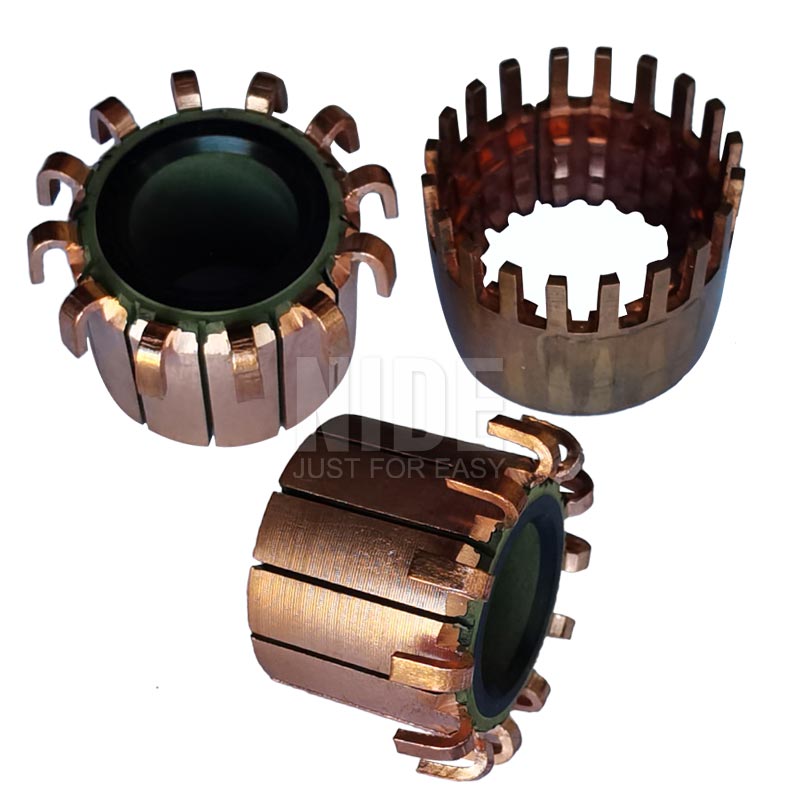
Reinforced resin and precision-stamped hook copper bars designed for hot-stacking and resistance welding in high-vibration automotive applications.
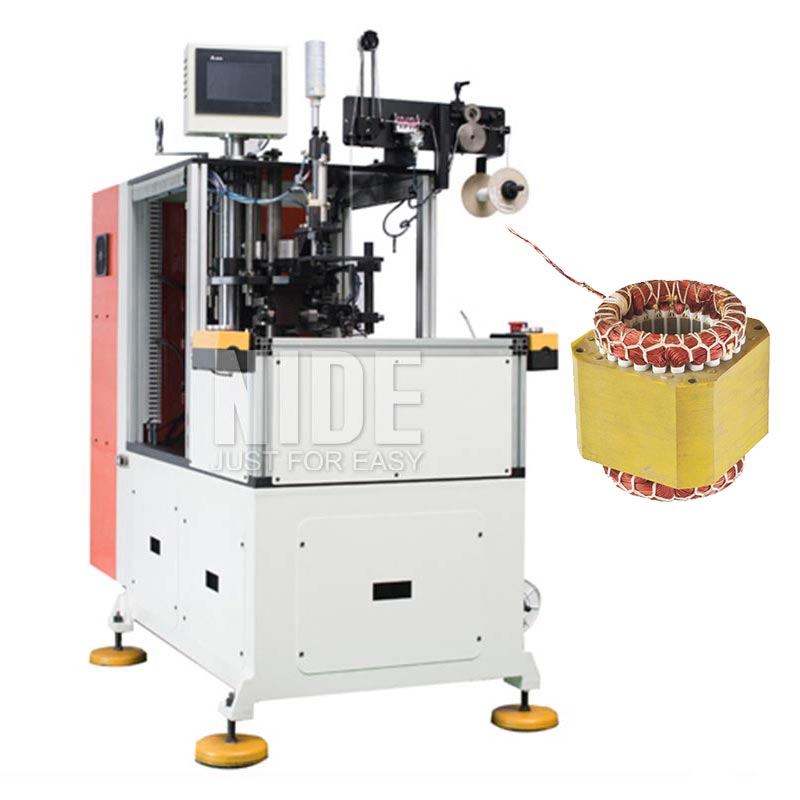
Dual-flyer servo-driven winding equipment equipped with real-time wire tension feedback, closed-loop indexing, and an intuitive touchscreen HMI.
Simultaneous twin-needle binding for pump, fan, and compressor induction motors. Programmable pitch lacing with needle-break detection sensors.
Full-cycle hairpin line encompassing 2D/3D copper wire bending, slot paper insertion, paper twisting, laser welding, and automated dielectric testing.
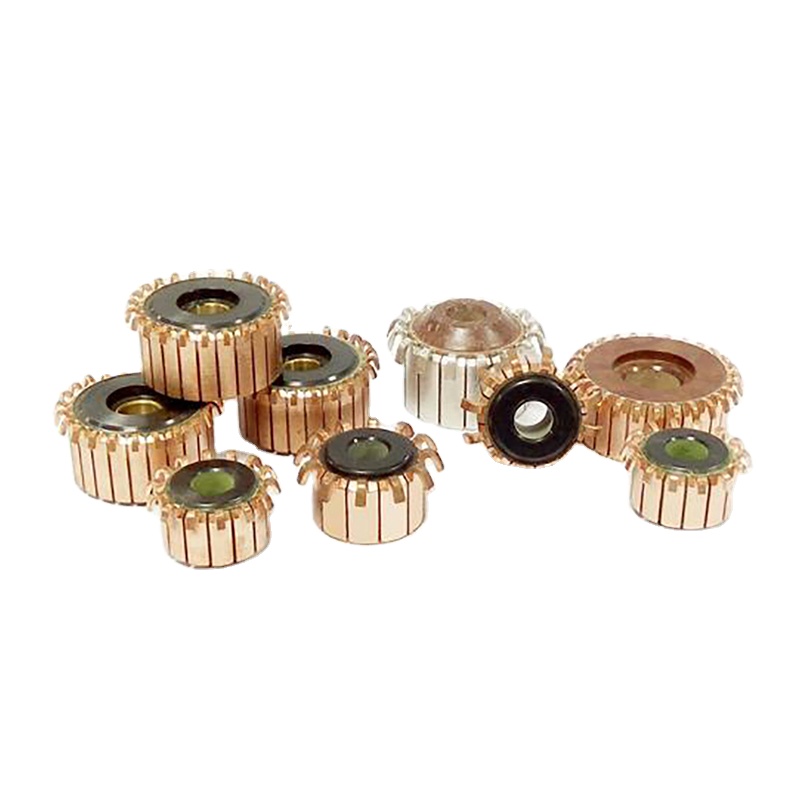
Silver-alloy copper bars delivering superior thermal conductivity and electrical discharge resistance under heavy continuous duty cycles.
Modern electric motor manufacturing has evolved beyond disconnected mechanical workstations into tightly coupled cyber-physical assembly cells. Whether producing universal fractional horsepower brush motors or high-voltage EV hairpin traction drives, achieving target energy efficiency (such as IEC IE4/IE5 or automotive NVH thresholds) depends directly on tooling rigidity, dynamic servo tension controls, and automated inline dimensional verification.
Critical Manufacturing Rule: Even minor variations in winding tension, slot insulation cuffing, or commutator hot-stacking resistance will result in localized thermal hotspots, partial discharge, and premature bearing or insulation breakdown. Precision tooling must manage copper elongation below 1.5% while sustaining maximum slot fill factor.
A high-yielding production line coordinates multiple specialized phases. The table below delineates typical kinematic boundaries, engineering controls, and machine tolerance requirements across the four dominant motor architectures manufactured across global tier-1 facilities:
| Motor Topology | Primary Assembly Operations | Critical Control Variables | Achievable Cycle Times (Takt) | Quality Checkpoint |
|---|---|---|---|---|
| Armature Universal / DC | Shaft press-fit, commutator seating, slot insulation, double-flyer winding, hook fusing | Flyer wire tension (±3cN), commutator bar runout (≤0.003mm), fuse temperature control | 12 – 22 seconds / rotor | 100% Bar-to-bar resistance, Surge, Hi-Pot (1800V AC) |
| Three-Phase Induction Stator | Insulation paper insertion, multi-spindle coil winding, simultaneous coil & wedge inserting | Wedge feeding stroke, coil height retention, end-turn cuff protection without enamel scrape | 25 – 45 seconds / stator | Slot wedge integrity, Hipot (2000V), 3-phase resistance balance |
| BLDC / PMSM Stators | Segmented core assembly, multi-axis needle winding, automated pin terminations, Hall PCB potting | Nozzle clearance, layer winding servo trajectory, zero scrape on tight tooth radius | 15 – 35 seconds / unit | Back-EMF symmetry, Inductance phase check, Partial discharge |
| EV Hairpin Traction Stator | Slot liner insertion, 2D/3D hairpin bending, paper basket loading, twisting, laser end-welding | Crown height uniformity (±0.1mm), laser beam positioning (±0.02mm), weld porosity ≤2% | 60 – 110 seconds / stator | Vision-guided optical weld analysis, 4-wire Kelvin resistance, PD test |
In traditional armature manufacturing, commutator fusing remains a primary source of field failure. When utilizing hot-stacking resistance welders, open-loop current transformers often fail to compensate for copper hook oxidation or micro-thickness variances in magnet wire enamel. Modern Nakro and NIDE-engineered machines resolve this through constant-energy closed-loop micro-weld controllers: the welder adjusts peak current and electrode downward displacement in microsecond intervals, ensuring the wire insulation is volatilized without annealing or embrittling the silver-copper alloy segment.
Similarly, in three-phase induction stators, our combined coil-and-wedge inserting technology uses hardened chrome-plated push-rods and flexible guided brass blades. By synchronizing the wedge feeding servo drive with the vertical coil insertion stroke, friction between the magnet wire and silicon steel slot teeth is reduced by up to 40%, completely eliminating wire pinching and insulation micro-cracking during phase barrier formation.
Plant directors and purchasing executives must evaluate key technological shifts before allocating CAPEX for motor assembly machinery.
EV drivetrains, urban e-mobility, and premium HVAC compressors are actively replacing round-wire stators with rectangular hairpin technology, boosting slot fill factor from ~45% to over 73% and demanding higher laser welding precision.
Global procurement teams require native OPC-UA and MQTT interfaces on assembly machines to track individual serial numbers, fusing curves, surge test traces, and torque-angle values across cloud ERP/MES architectures.
High-mix low-volume motor factories are shifting away from fixed tooling toward modular fixture designs and servo-programmable recipe adjustments, cutting stack-height conversion times down from 4 hours to under 20 minutes.
Assembly line operators demand machinery with direct-drive torque motors and kinetic energy recovery systems, driving down machine idling power consumption while boosting dynamic positioning responsiveness.
Our Ningbo manufacturing base provides turnkey automation machinery, customized tooling, and matched component supplies that reduce procurement fragmentation.
We deliver full automated lines—from lamination stacking and shaft press-fitting to needle winding, dynamic balancing, vacuum impregnation, and end-of-line electrical verification—eliminating line integration risks between disparate vendors.
Alongside our machinery, we engineer and supply matched motor components: silver-copper commutators, molded brush holders, precision-machined shafts, ball bearings, and specialized magnetics, guaranteeing seamless mechanical fits.
Prior to shipment, every machine undergoes continuous full-speed trial runs utilizing the customer's actual lamination stacks, copper wire, and components. Customers receive detailed capability studies (Cpk ≥ 1.67) and run-off video proofs.
A five-stage framework structured to eliminate mechanical rework and ensure smooth commissioning for overseas motor plants.
Detailed evaluation of rotor/stator 2D drawings, slot geometry, copper wire diameter, and production volume requirements.
CAD/CAM tooling design for inserting fingers, winding nozzles, and clamping collets utilizing hardened SKD11/tungsten carbides.
Full machine construction followed by 48-hour continuous test runs using customer-supplied raw components at target takt speed.
Vacuum-sealed barrier protection, anti-corrosive treatments, and shock-isolated heavy-duty wooden crate packaging for ocean freight.
Field commissioning by experienced mechanical and electrical engineers, complete with PLC recipe operator training and wear parts.
Clear answers on tooling capabilities, maintenance, and overseas commissioning logistics.
Submit your stator/armature technical drawings, target takt times, and annual output goals. Our process design team will deliver a comprehensive machine station list, line layout, and quotation within 24 hours.