Featured Motor Manufacturing Lines & Rotor Assemblies
Configured specifically to buyer lamination geometry, slot fill optimization, and high-duty cycle industrial reliability across power tools, e-mobility, and industrial machinery.
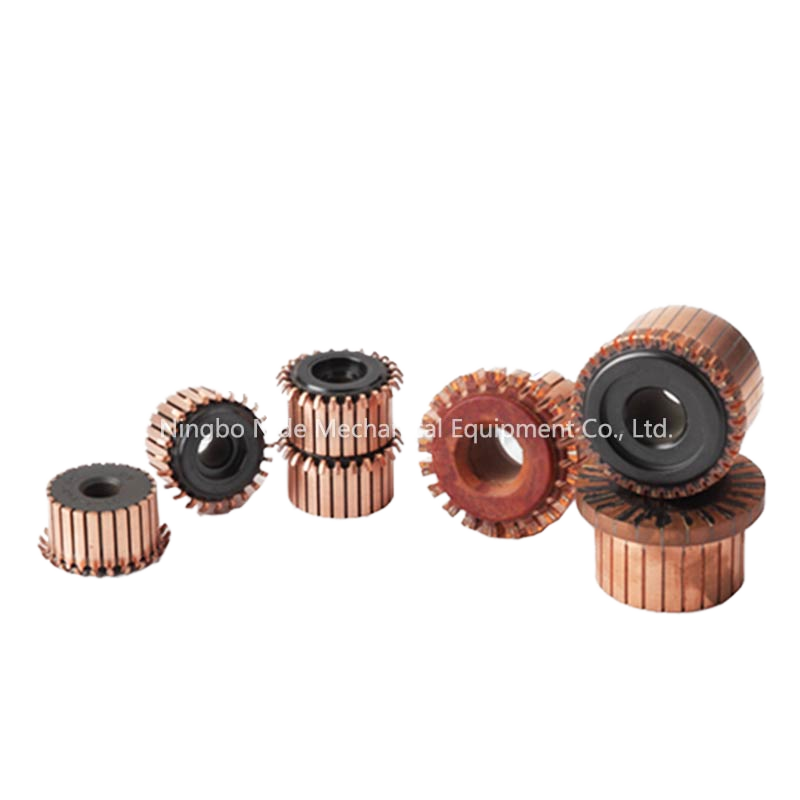
High Precision DC Motor Armature Collector Slip Ring Commutator with Rotor Stator Fan NIDE Brand Model NDPJ-HXQ CE Certified
Engineered for high-torque DC motors, featuring high thermal conductivity silver-bearing copper segments, precision molded mica dielectric insulation, and integrated dynamic balancing fans.

24 Segments Hook Type DC Electric Motor Starter Armature Rotor Commutator Grinder Motor Accessories NIDE Brand Model NDPJ-HXQ-14
Solid 24-hook structure fabricated for heavy-duty angle grinders and automotive starters, guaranteeing low bar-to-bar resistance, spark-free commutation, and high centripetal burst tolerance.

New Rotor Winding Equipment with Engine & Motor Core Components PLC Controlled Armature Winder Machine 1 Year Warranty
High-speed dual-flyer servo-driven winding equipment equipped with closed-loop wire tension control, precise CNC hook index positioning, and rapid tooling changeover systems.
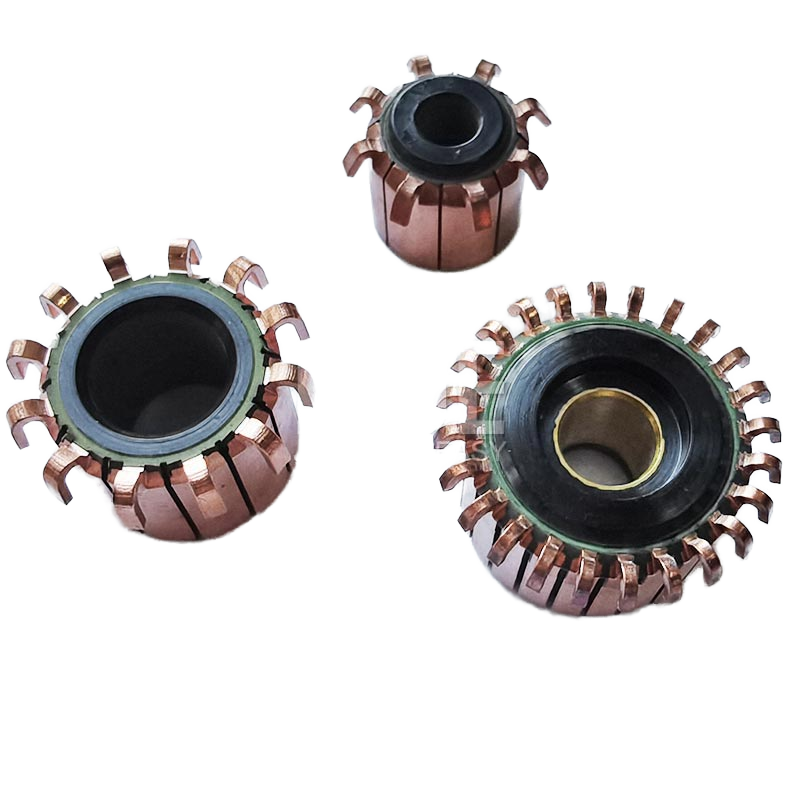
Universal Household Juicer Mixer DC Motor Armature Hook Commutator Part Stamping Rotor Stator NIDE Brand Model NDPJ-HXQ-183
Complete armature stamping, precision hook commutator fusion, and epoxy-powder-coated rotor core solutions optimized for high-RPM domestic food processing appliance motors.
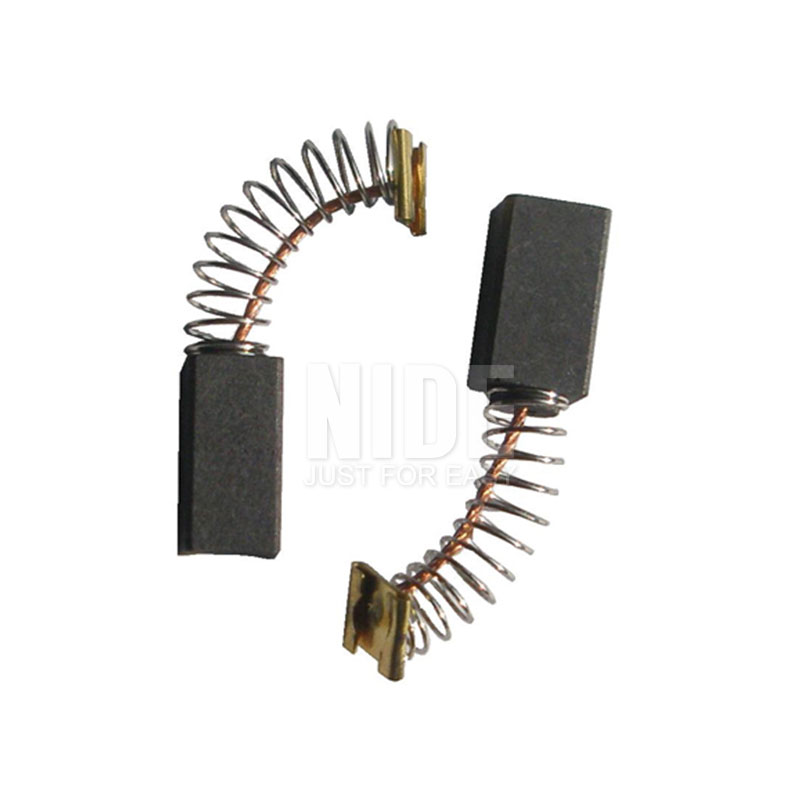
High Precision DC Motor Magnet Alternator Carbon Brushes NIDE Brand Model NDPJ-TS-7 CE Certified for Motor Electrical
Electro-graphite and metal-graphite composite formulations providing self-lubricating wear resistance, low contact voltage drop, and high thermal stability under continuous heavy loads.

Automatic PLC Controlled BLDC Motor Rotor Magnet Inserting Machine Engine for Brushless DC Motor Manufacturing Plant Use 1 Year
Automated dispensing, orientation, and optical polarity verification for IPM and SPM brushless permanent magnet rotors, preventing magnetic flux misalignment and core delamination.
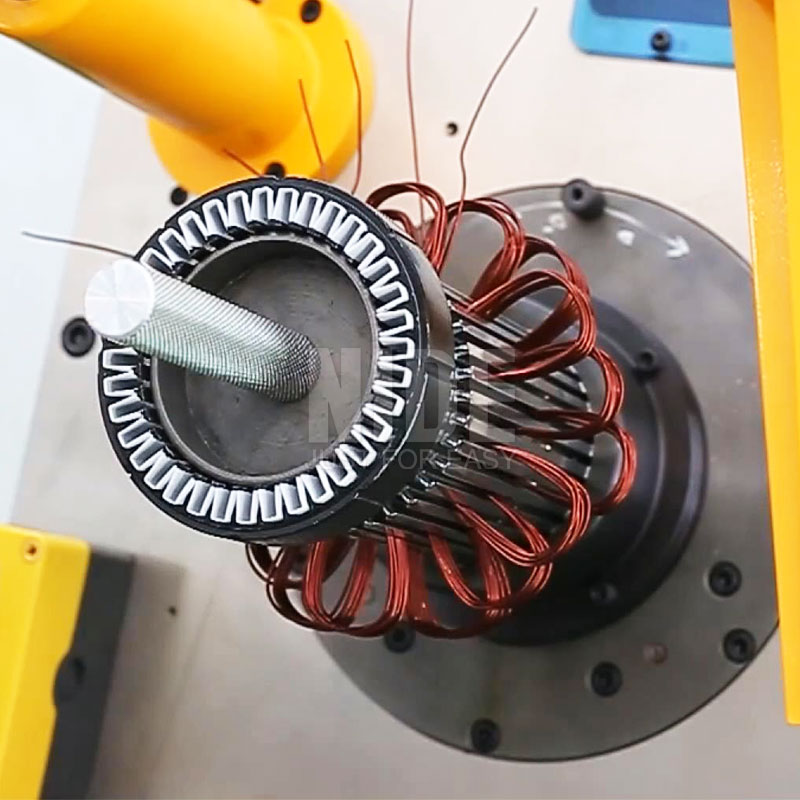
Automatic Single Phase Motor Stator Coil Insertion Machine Industrial Equipment Engine PLC Core Components 1 Year CE Certified
Simultaneous copper coil and slot wedge push insertion driven by synchronized servo mechanics, protecting wire enamel integrity across fractional horsepower motor stators.
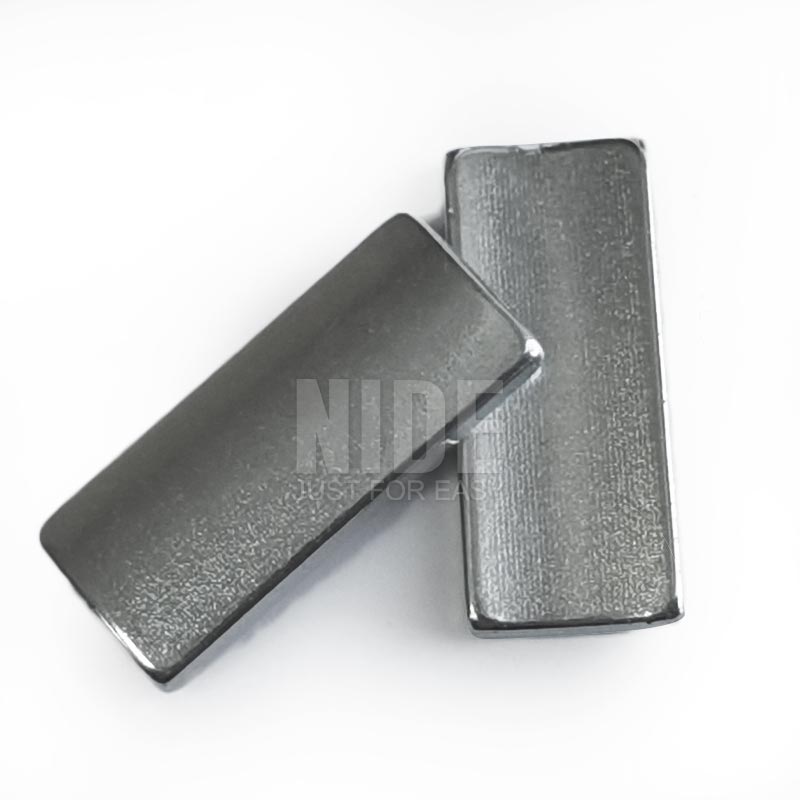
Rectangular N52 NdFeB Neodymium Magnets Strong Block for Motor Accessories NIDE Brand Model NDPJ-CW-58
Ultra-high remanence sintered rare-earth neodymium blocks with triple Ni-Cu-Ni anti-corrosion barrier plating, designed for high-power-density EV traction rotors and servo motors.
Turnkey Rotor Die Casting Line Engineering & Metallurgical Control
Achieving zero-porosity, high electrical conductivity, and high dimensional repeatability in industrial squirrel-cage induction motor rotor production cells.
In the global electric motor manufacturing sector, squirrel-cage induction rotors remain the cornerstone of industrial drivetrains, HVAC compressors, water pumps, and electric vehicle traction systems. However, as international efficiency regulations transition progressively toward IEC 60034-30-1 IE3 (Premium Efficiency), IE4 (Super Premium), and IE5 (Ultra Premium) classifications, the metallurgical, mechanical, and thermal parameters of the rotor die casting line have become the single most critical determinator of motor energy efficiency and operational life.
Critical Metallurgical Imperative: Conductivity vs. Porosity
A variation of only 2% in the electrical conductivity of cast aluminum or copper conductor bars can shift an induction motor below its statutory IE3 or IE4 threshold. Porosity, oxide inclusions, cold shuts, and inter-laminar short circuits induce severe parasitic eddy currents, excessive thermal dissipation, and destructive rotor unbalance at standard operational frequencies.
Lamination Skewing & Clamping
Precision hydraulic servo presses compress high-permeability silicon electrical steel lamination packs to strict stack-height tolerances. Continuous torque-controlled spiral mandrels enforce accurate slot skewing angles (typically 1 to 1.5 stator slot pitches) to suppress slot harmonics, minimize electromagnetic torque ripple, and eliminate synchronous crawling.
Robotic Ladling & Dosing
Multi-axis industrial articulated robots equipped with titanium-coated ceramic ladles transfer molten aluminum (A00 grade, ≥99.7% purity) from central reverberatory or electric holding furnaces. Precision weight-dosing algorithms ensure volume accuracy within ±1.5 grams, preventing shot sleeve underfill and turbulent air entrainment.
Real-Time Closed-Loop Injection
High-tonnage cold chamber die casting presses employ real-time servo-hydraulic valves operating on sub-millisecond response curves. Multi-stage injection separates slow laminar filling (to evacuate mold cavity gases) from high-velocity cavity pack and ultra-high-pressure hydraulic intensification (up to 120 MPa) to crush micro-shrinkage voids.
Engineering Evaluation: Vertical vs. Horizontal Rotor Die Casting Lines
Selecting the optimal kinematic orientation, cavity pressure dynamics, and scrap reclamation profile for low-voltage, medium-voltage, and automotive-grade motor rotors.
| Performance / Operational Metric | Vertical Cold Chamber Casting Cell | Horizontal High-Pressure Casting Cell | Technical Significance for Motor Production |
|---|---|---|---|
| Lamination Pack Clamping Force | Vertical hydraulic ram clamping (800 – 3,500 kN directly aligned with stack axis) | Toggle mechanical clamp or side tie-bar hydraulic lock (1,200 – 6,000 kN) | Direct axial clamping prevents molten aluminum from flashing between silicon steel laminations, eliminating inter-laminar short circuits and eddy current losses. |
| Molten Metal Flow Velocity & Porosity | Bottom-up laminar filling; air naturally vents upward through mold exhaust channels. | Horizontal high-velocity shot; requires vacuum extraction to eliminate air pockets. | Vertical casting yields higher structural density in small-to-medium rotor conductor bars, whereas horizontal systems excel when equipped with active vacuum chill vents. |
| Tooling & Mold Thermal Life | H13 / Dievar tool steel: ~100,000 to 180,000 shots with internal conformal oil cooling. | Premium tool steel: ~80,000 to 140,000 shots under higher thermal shock regimes. | Conformal heating and cooling channels maintain stable die face temperatures (200°C – 260°C), avoiding thermal fatigue cracking and dimensional drift on rotor end rings. |
| De-Gating & Runner Scrap Ratio | Low scrap volume: Runner and biscuit are directly situated beneath bottom end-ring. | Moderate to high: Requires runner branching and overflow wells on peripheral gates. | Vertical casting cuts remelt costs and oxidation dross formation by reducing runner weight by 22% to 35% per casting cycle. |
| Cycle Time & Line Automation | 45 – 70 seconds/shot (incorporating auto pack insert, cast, quench, and auto-trim). | 35 – 55 seconds/shot (higher multi-cavity efficiency for fractional HP motors). | Horizontal systems dominate small, high-volume consumer appliance rotors; vertical lines dominate industrial pump, compressor, and traction motor rotors. |
Global Sourcing Forecast: Rotor Die Casting Procurement Trends (2025–2035)
How Tier-1 automotive groups and industrial pump/compressor OEMs are restructuring procurement mandates to meet stringent decarbonization and operational efficiency metrics.
Transition to High-Conductivity Copper Rotor Casting
Driven by IE4 and IE5 standards, international motor builders are increasingly specifying die-cast copper rotors. Because pure copper melts at 1,085°C (compared to 660°C for aluminum), procurement teams are actively sourcing high-tonnage casting machines equipped with refractory metal tooling (tungsten-molybdenum alloys) and vacuum-assisted chambers to mitigate mold thermal wash and copper oxidation.
Integrated Industry 4.0 SCADA & Cavity Telemetry
Global procurement criteria have shifted away from standalone mechanical presses toward fully digitized manufacturing cells. Turnkey lines now require embedded shot-sleeve pressure transducers, infrared die-face thermography, and OPC-UA communication architecture that logs lamination batch ID, molten metal temperature, and injection curves for 100% downstream trace-back.
Modular Turnkey Cells with In-Line Secondary Operations
Procurement directors are phasing out disjointed multi-vendor manufacturing layouts. The contemporary requirement demands complete, integrated cells: automatic lamination loading, induction preheating (to prevent thermal shock), robotic casting, automatic hydraulic trimming, rotor shaft press-fitting, CNC balance turning, and inline eddy-current testing within one footprint.
Emerging Engineering Horizons in Rotor Foundry & Assembly Systems
Pioneering advancements shaping the next generation of high-speed e-mobility traction motors, hermetic compressor drives, and servo automation.
As rotational velocities for automotive traction motors push past 20,000 RPM, the mechanical integrity of cast squirrel-cage end-rings and conductor bars is subjected to immense centrifugal shear stress. Traditional gravity casting and standard die casting techniques can no longer satisfy the structural thresholds required for these ultra-high-speed operational profiles.
Ultrasonic Degassing & Melt Conditioning
To ensure 100% electrical conductivity in cast aluminum bars, modern production cells incorporate ultrasonic sonotrodes into the dosing furnace. High-power ultrasonic acoustic cavitation drives dissolved hydrogen gas out of the melt and breaks down intermetallic iron-silicon needle structures into ultra-fine equiaxed grains, elevating mechanical tensile yield strength by over 18%.
Controlled Atmosphere & Vacuum Extraction
Advanced horizontal and vertical casting cells operate under high-vacuum conditions (cavity absolute pressure ≤30 mbar prior to metal shot). Removing ambient air completely eradicates micro-porosity caused by trapped nitrogen and moisture, achieving homogeneous metal density equivalent to forged material and virtually eliminating broken rotor bar defects.
AI-Powered In-Line Eddy Current Testing
Automated lines integrate multi-frequency rotary eddy current sensors immediately downstream of rotor cooling stations. Deep-learning inspection algorithms analyze electrical conductivity signatures across all conductor bars within 6 seconds per rotor, instantly detecting broken bars, cold voids, or skewed slot necking without destructive cross-sectioning.
Enterprise Strengths & Factory Infrastructure: Ningbo Nakro Intelligent Equipment
A proven engineering legacy delivering specialized motor manufacturing machinery, precision component integration, and turnkey automation lines worldwide.
Headquartered in the advanced manufacturing hub of Ningbo, Zhejiang, Ningbo Nakro Intelligent Equipment Co., Ltd. (operating within the authoritative NIDE brand ecosystem) has spent over 13 years engineering high-precision machinery for global electric motor manufacturers. Our 30,000+ square meter campus houses specialized R&D engineering divisions, CNC precision tooling centers, electrical assembly workshops, and comprehensive customer acceptance testing cells.
One-Stop Turnkey Capability
Nakro bridges the gap between machinery manufacturing and motor component supply. Beyond building automated rotor die casting lines, stator winding equipment, and coil inserting systems, we supply matching precision commutators, carbon brushes, insulation papers, permanent magnets, and dynamic balancing assemblies, guaranteeing single-source project accountability.
Custom Tooling & R&D Specialization
Our engineering department employs over 35 mechanical, electrical, and metallurgical design specialists. We engineer custom tooling profiles, multi-cavity rotor dies, coil inserting blades, and flyer winding nozzles precisely tailored to customer slot geometries, lamination thicknesses (0.20mm to 0.50mm), and high-fill-factor winding configurations.
Rigorous 6-Stage QC & Pre-Shipment Run-Off
Every piece of machinery undergoes our ISO 9001 certified 6-point verification: incoming raw material metallurgy check, precision CNC coordinate measuring (CMM), electrical control cabinet functional test, 72-hour continuous trial run with buyer materials, electrical sample hipot/surge testing, and heavy-duty seaworthy export crating.
Frequently Asked Questions: Sourcing Rotor Die Casting Lines
Direct engineering responses to critical questions encountered by overseas plant directors, procurement managers, and production engineers.
Request a Customized Rotor Die Casting Line Proposal
Whether you are setting up an automated greenfield motor foundry, replacing manual casting cells, or upgrading to IE4/IE5 efficiency standards, our senior technical engineers will analyze your motor drawings, slot skew geometries, and target output to formulate a tailored engineering layout and competitive commercial quotation.
