Procurement Knowledge Base
Frequently Asked Questions: Industrial Rotor Production Lines
Direct answers to the most common commercial, electrical, mechanical, and delivery questions asked by plant managers and procurement officers.
What rotor topologies and dimensions can your automatic production line accommodate?
+
Our lines are engineered to process armatures for universal motors, DC starter motors, vacuum cleaners, and cordless power tools, as well as brushless DC (BLDC) inner/outer rotors, permanent magnet synchronous motor (PMSM) rotors, and e-bike wheel hub motor assemblies. Standard shaft diameters range from Ø3 mm to Ø32 mm, rotor outer diameters (OD) from Ø15 mm to Ø180 mm, and lamination stack heights from 10 mm to 250 mm. Custom configurations for larger traction or industrial compressor rotors can be engineered upon reviewing your engineering 2D/3D part prints.
How does the factory conduct Factory Acceptance Testing (FAT) before overseas dispatch?
+
We follow a standardized, milestone-based FAT protocol. The buyer supplies actual sample components—including shafts, lamination stacks, commutators, insulation paper, and enamelled copper magnet wire. Our engineering team conducts continuous batch trial runs consisting of 500 to 2,000 test rotors. We document cycle time, mechanical run-out tolerances, insulation dielectric leakage (Hipot > 1,800V), surge waveform repeatability, and CPK metrics. Complete video logs, dimensional measurement reports from our CMM, and sample shipments are sent for buyer sign-off. Buyers are also welcome to attend the acceptance trial in person at our Ningbo manufacturing facility.
What is the standard delivery timeline for a complete automatic rotor production line?
+
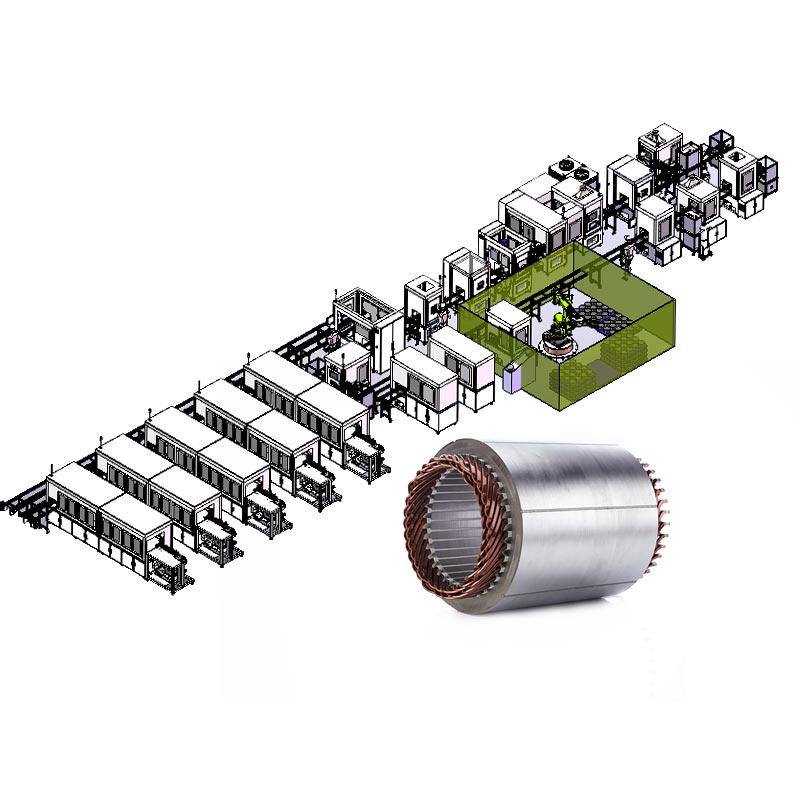
Stand-alone units (such as individual dual-flyer winding cells or commutator turning lathes) generally ship within 45 to 60 calendar days. Fully automated turnkey rotor lines—including automatic pallet conveyor transfer, hot staking, trickle impregnation, dynamic balancing, and inline test stations—require approximately 90 to 120 calendar days from formal engineering print sign-off and receipt of tooling down payment. Expedited modular cells can be arranged depending on factory loading schedules.
Can we specify our preferred PLC, servo drives, and pneumatic component brands?
+
Yes. As a dedicated OEM/ODM machinery builder, we accommodate customer-specific plant component standards. Our standard platforms leverage Siemens S7-1500 / Mitsubishi iQ-R series PLCs, Mitsubishi / Yaskawa / Panasonic servo drive systems, Weinview / Pro-face / Siemens industrial touchscreens, and SMC / Festo pneumatic components. Sensor architectures can be standardized to Keyence, Omron, or Sick, and electrical cabinets can be wired to comply with CE, NFPA 79, or UL508A safety codes.
What after-sales service and on-site commissioning support is provided overseas?
+
We maintain seasoned field service engineers equipped for international deployment. Upon arrival of the sea freight crates at your facility, our technicians oversee mechanical line placement, electrical drop connections, pneumatic integration, and on-site Site Acceptance Testing (SAT). We conduct multi-day maintenance and operator training modules covering mechanical calibration, wire changeovers, and electrical troubleshooting. In addition, all lines feature built-in remote industrial VPN gateway access, allowing our Ningbo software engineers to provide live PLC diagnostic telemetry within hours of any service request.
How does the machinery prevent copper enamel wire stripping and stress during high-speed winding?
+
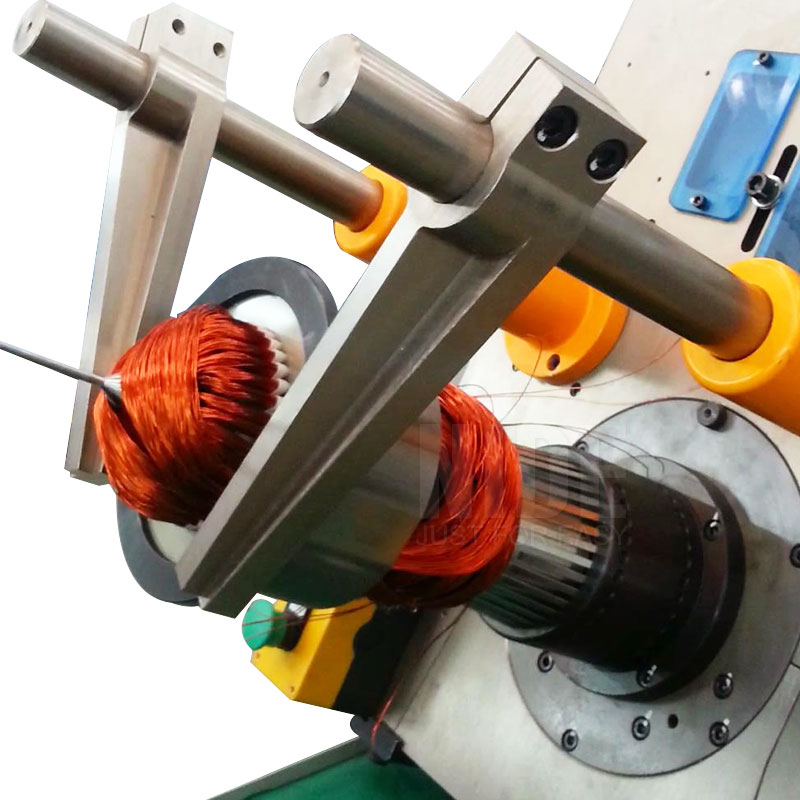
Our dual-flyer winding spindles utilize magnetic powder or closed-loop servo-regulated tension controllers paired with mirror-polished, solid ceramic wire eyelets and tungsten carbide guide nozzles. As flyer velocity accelerates up to 3,500 RPM, the tension controller dynamically modulates back-tension based on angular flyer positioning. This limits wire elongation to under 1.5%, preventing microscopic enamel cracking, turn-to-turn micro-shorts, and premature thermal insulation failure in the field.
What international commercial trade terms and payment methods are accepted?
+
We routinely operate under standard Incoterms 2020 including FOB (Ningbo / Shanghai), CFR, CIF, and DAP terms. Payment currencies include USD, EUR, and CNY. Standard contract terms are structured as a 30% T/T engineering deposit upon design confirmation, 60% T/T following successful FAT milestone sign-off, and the final 10% balance payable upon bill of lading presentation or against an irrevocable Letter of Credit (L/C at sight) from an established Tier-1 international bank.