Featured Motor Production Equipment & High-Grade Components
Precision-engineered standalone winding machines, automated coil inserters, and OEM-grade motor components custom-configured to stator stack dimensions, slot geometries, and winding wire specifications.
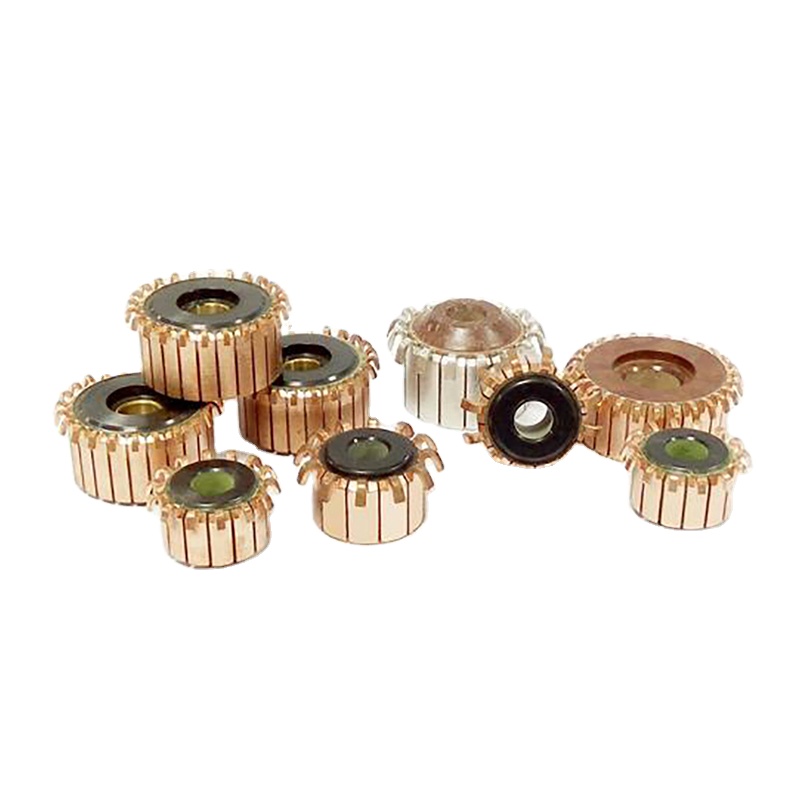
Factory Wholesale 12V Commutator for Power Tools NDPJ-HXQ-03007
- Silver-copper alloy segment bars
- High dielectric mica/phenolic molding
- CE certified for universal DC armatures
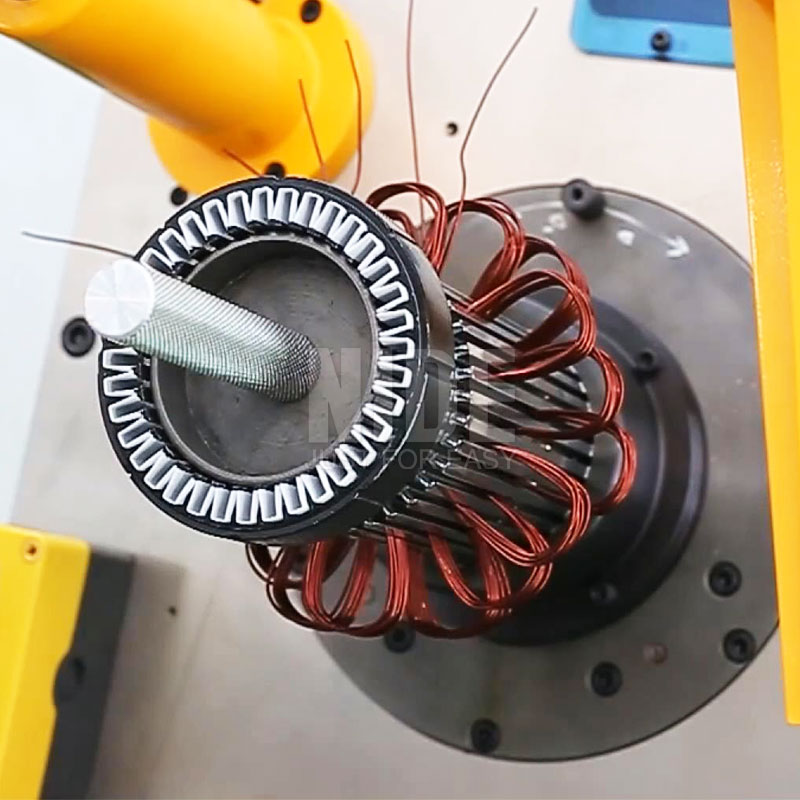
Automatic Single Phase Motor Stator Coil Insertion Machine
- Simultaneous wire and wedge insertion
- Integrated PLC control & HMI touchscreen
- High slot fill rate with zero insulation tear
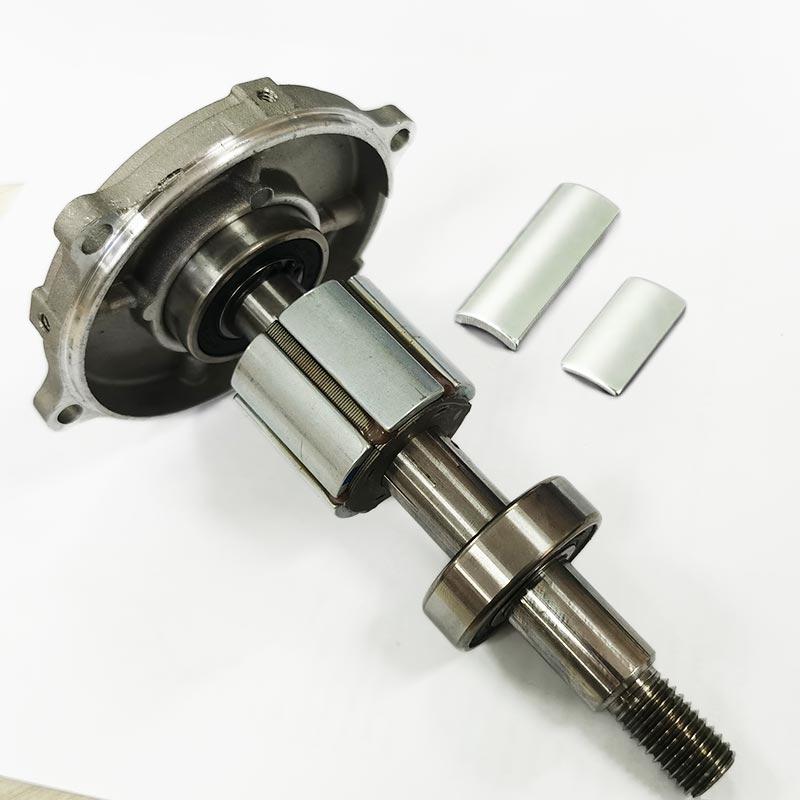
Customized N52 Sintered Neodymium Rotor Magnets NDPJ-CW-62 3
- Ultra-high remanence (Br) & coercive force
- Triple Ni-Cu-Ni anti-corrosion coating
- Optimized flux curve for PMSM / BLDC rotors
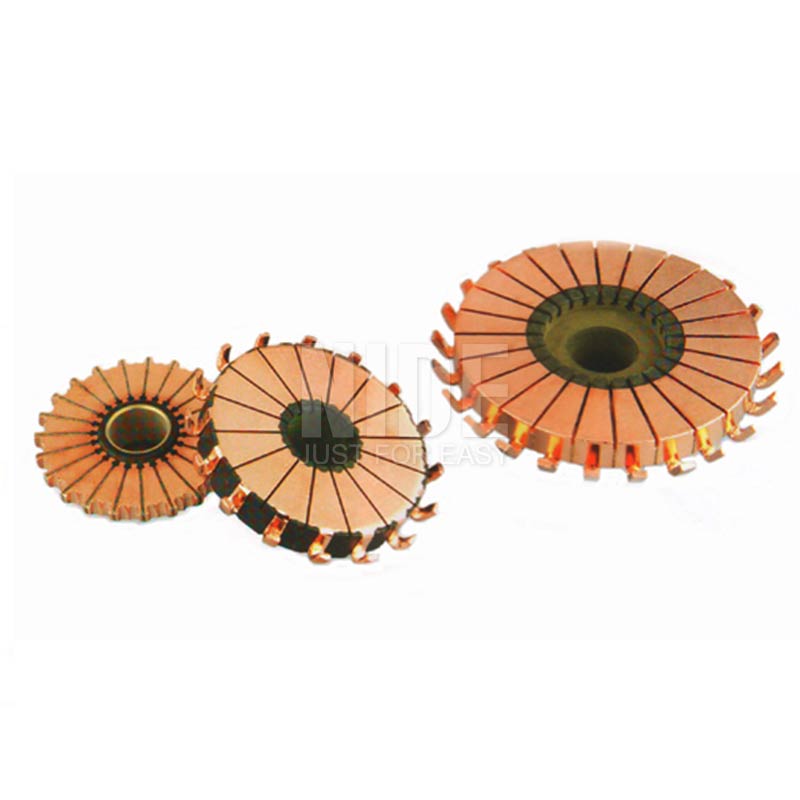
Planar Type Flat Commutator Component NDPJ-HXQ-39
- Low-profile axial face contact design
- Excellent wear resistance for automotive pumps
- Precision copper surface planarity <0.003mm
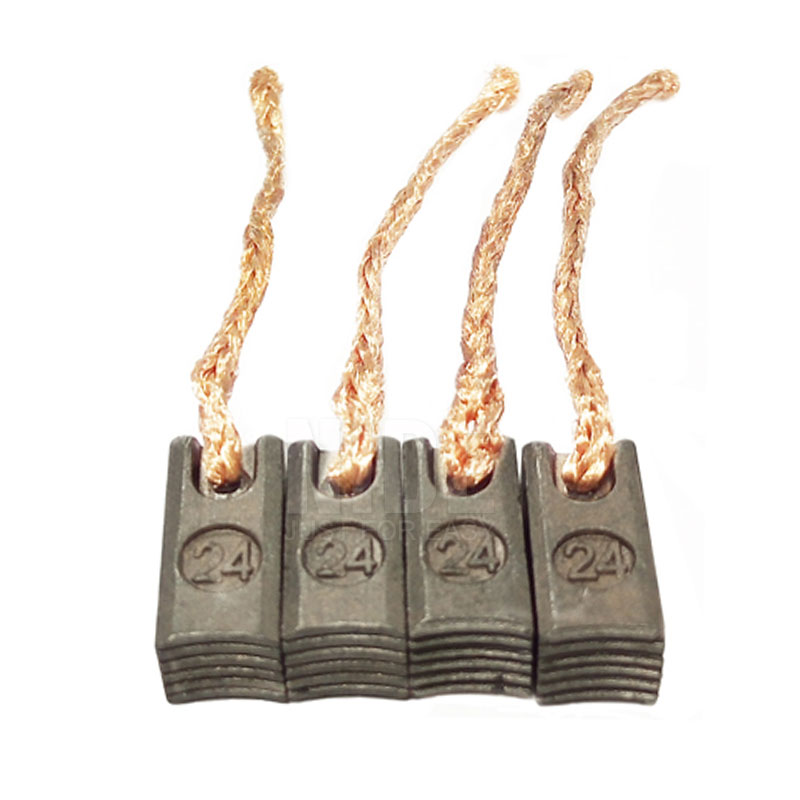
High Precision Motor Carbon Brushes NDPJ-TS-9
- Electrographite & copper-graphite blends
- Minimal electrical sparking & extended brush life
- Low contact drop for high-speed appliance motors
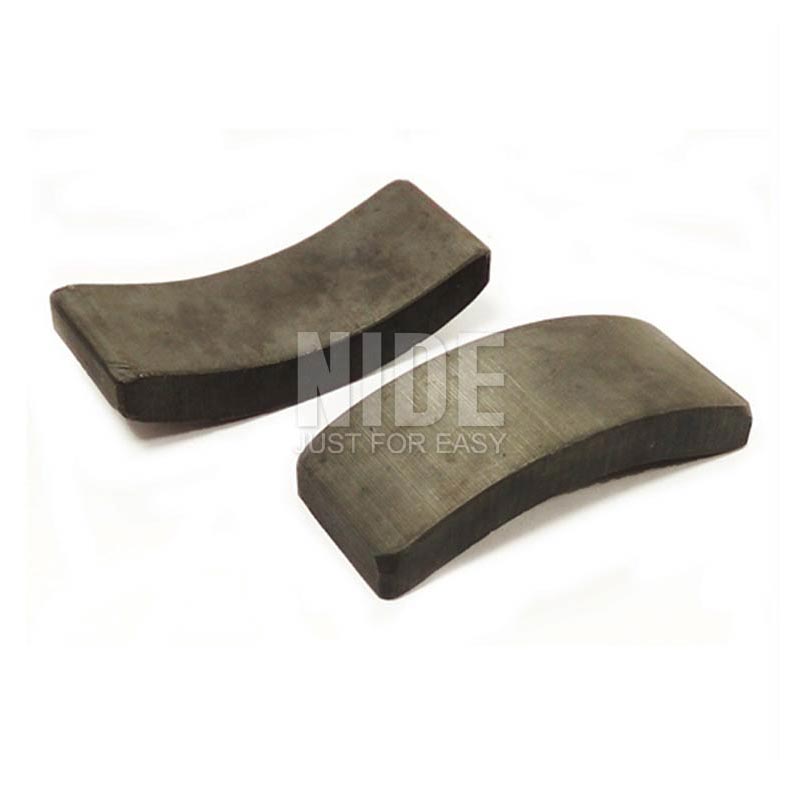
Permanent Arc Segment Ferrite Magnets for 12-220V DC Motors
- Anisotropic ceramic strontium ferrite
- Cost-effective magnetic stator housing lining
- High demagnetization resistance under heat
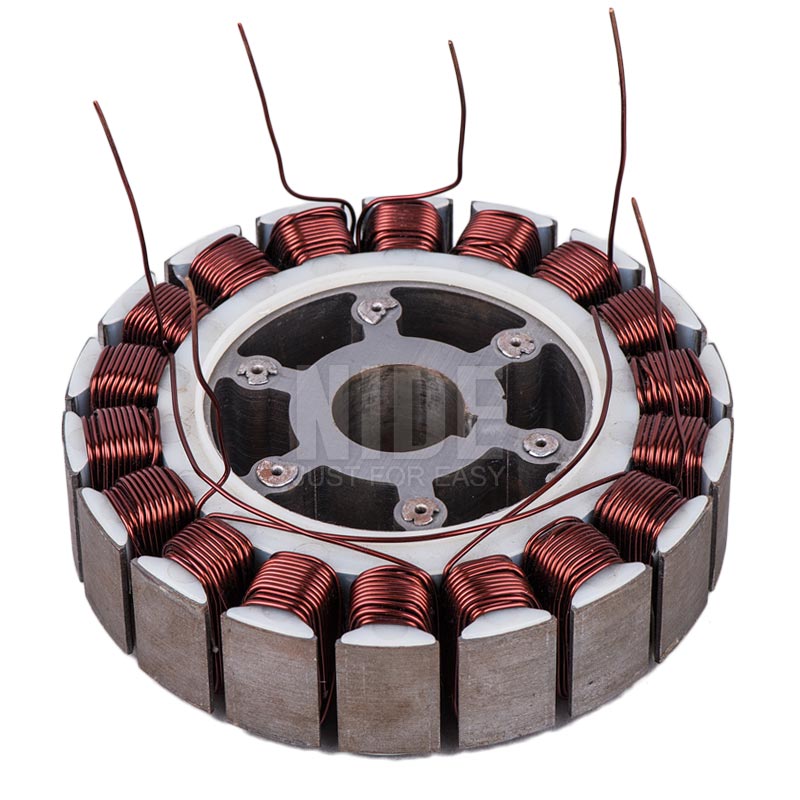
Automatic BLDC Wheel Motor Stator Needle Winding Machine
- CNC multi-axis servo fly-needle winding
- Specialized for outer-rotor e-bike hub motors
- Real-time active tension control mechanism
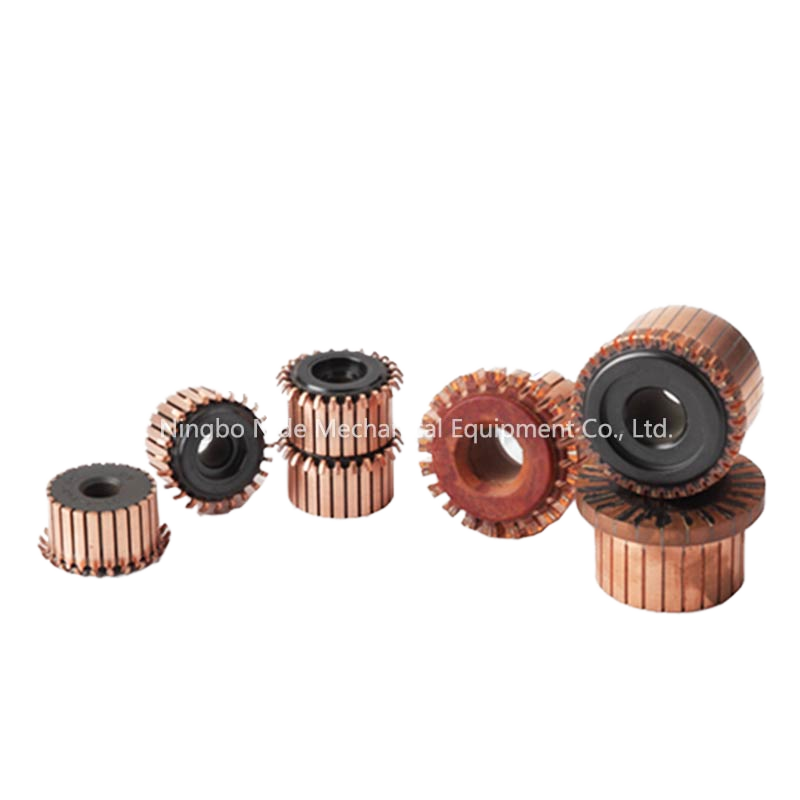
DC Motor Armature Collector Slip Ring Commutator Assembly
- Integrated precision slip ring & hook riser
- Compatible with rotor cooling fan balancing
- Certified spin-tested mechanical integrity >20,000 RPM
Technological Evolution in Electric Motor Production Equipment
How Chinese machinery manufacturers are redefining electromechanical automation through multi-axis direct-drive servo synchronization, closed-loop wire tensioning, and intelligent optical vision quality control.
The global transition toward high-efficiency industrial motors (IE4 and IE5 standards), automotive electrification (EV traction and auxiliary drive motors), and high-density micro-mobility drivetrains has fundamentally transformed the requirements placed on electric motor manufacturing machinery. Conventional mechanical-cam winding equipment and manual coil insertion stations are no longer capable of meeting the stringent tolerance limits, slot-fill factors (often demanding copper densities exceeding 78% in hairpin and compact needle winding architectures), and low thermal variance parameters necessary for modern commercial deployment.
Contemporary production machinery manufactured in top-tier Chinese industrial hubs—specifically Ningbo and the broader Yangtze River Delta—incorporates high-speed CNC multi-axis servo interpolation, dynamic digital tension feedback loops, and intelligent thermal-fusing diagnostics. These structural advancements eliminate mechanical stress on copper enameled wire, safeguarding the micro-thin polyamide-imide enamel layer against micro-fracturing and dielectric breakdown during rapid flyer rotation and needle guide strokes.
Technical Imperative: In high-speed BLDC and PMSM stator winding, wire elongation must be restrained strictly under 1.5% to maintain uniform copper ohmic resistance across all three phases (U, V, W). Modern Chinese winding machines deploy active servo-driven unwinding and piezoelectric closed-loop tensioners capable of compensating wire speed variations up to 3,000 RPM with millisecond reaction times.
Hairpin & High-Density Needle Winding
Transitioning from random round-wire wound stators to concentrated segmented-tooth needle winding and rectangular-wire hairpin forming. This increases the slot fill ratio up to 80%, optimizes heat conduction directly to the laminated iron core, and shrinks total motor footprint by 25%.
Precision Commutator Hook Micro-Fusing
Utilizing intermediate-frequency inverter DC or laser resistance fusing technology. By dynamically monitoring electrical voltage, displacement collapse depth, and peak current profiles in real time, machines ensure carbon-free, metallurgically bonded joints with zero annealing embrittlement.
In-Line Optical & Dielectric Diagnostics
Integration of automated 3D machine vision cameras alongside integrated electrical testing stations: performing surge tests, high-potential (hipot) resistance, inter-turn impulse insulation checks, and micro-ohm direct current resistance (DCR) validation directly within the production indexing ring.
Future Procurement Trends for Global Motor Manufacturers
How international OEM and Tier-1 engineering procurement departments are transitioning from fragmented individual machine acquisition to integrated turnkey lines with single-source accountability.
For over two decades, global procurement strategies in the electric motor sector typically fragmented the procurement chain: purchasing armature winders from European or Taiwanese builders, lamination stamping dies locally, commutator inserting units from secondary specialists, and sourcing insulation paper separately. However, the accelerated complexity of smart BLDC stators and outer-rotor e-mobility drivetrains has made this decentralized approach inefficient and commercially risky.
Contemporary procurement heads are executing holistic vendor consolidation models. Leading manufacturing clusters in China, spearheaded by integrated players such as Ningbo Nakro Intelligent Equipment Co., Ltd., offer complete process orchestration: from raw lamination stacking, slot paper insertion, and precision flyer winding, to commutator turning, dynamic rotor balancing, and automated magnet assembly. Sourcing complete automated turnkey assembly lines from a single verified manufacturer dramatically reduces interface commissioning errors, standardizes PLC software architectures (e.g., Mitsubishi, Siemens, or Omron platforms), and slashes overall capital expenditures (CAPEX) by 35% to 50%.
| Evaluation Parameter | Legacy Fragmented Sourcing | Next-Gen Chinese Turnkey Line Model | Procurement Impact |
|---|---|---|---|
| Cycle Time Synchronization | Bottlenecks at manual station transitions; inconsistent tact times | Unified servo indexing and automated conveyer transfer (tact ≤ 12s) | +40% Output Efficiency |
| Tooling & Spare Part Flexibility | Multiple proprietary tooling standards; complex spare stocks | Modular quick-change collets, nozzles, and inserts standardized across line | -60% Tooling Changeover Time |
| Quality Traceability | Decentralized station logs; difficult root-cause tracking | Centralized SCADA/MES data recording; barcode/RFID part tracking | Zero-Defect PPM Control |
| Supplier Accountability | Vendor finger-pointing during dimensional or insulation failures | Single-source engineering liability from coil to finished tested motor | Minimized Project Risk |
| Total CAPEX & Tooling Cost | Substantial markups, multiple logistical channels and tariffs | Direct industrial cluster wholesale economies of scale (Ningbo base) | 35% - 50% Capital Savings |
Furthermore, smart factory initiatives have made IIoT (Industrial Internet of Things) connectivity an indispensable purchasing criterion. Machinery must feature integrated industrial Ethernet protocols (Profinet, EtherCAT, or Modbus TCP) allowing international buyers to monitor line performance, predictive maintenance flags, and tooling wear profiles remotely from central engineering headquarters.
Turnkey Motor Line Implementation Roadmap
From customer lamination CAD analysis to on-site trial run approval: our ISO 9001 certified five-stage project engineering methodology ensures zero tolerance deviations.
Drawing & Slot Audit
Detailed evaluation of stator/armature blueprints, slot opening dimensions, stack skew angles, copper wire gauges, and target shift volume.
Custom Tooling & Simulation
CAD/CAM modeling of winding flyer needles, wedge guide blades, and expanding insertion tooling configured specifically to lamination geometry.
Precision Machine Assembly
CNC precision machining of structural frames, electrical cabinet wiring, PLC programming, and rigorous internal sub-assembly testing.
Run-Off With Buyer Parts
Comprehensive factory trial using customer-supplied raw laminations, commutators, and magnet wire, verified via high-definition video documentation.
On-Site Commissioning
Global dispatch of senior electrical and mechanical field service engineers for facility installation, operator training, and final line sign-off.
Why Global Motor Manufacturers Partner With Ningbo Nakro
Founded in 2010 in Ningbo, Zhejiang, Ningbo Nakro Intelligent Equipment Co., Ltd. combines specialized machinery fabrication with comprehensive component manufacturing for complete electric motor success.
ISO 9001 Certified System
Rigorous full-lifecycle quality control protocols. Every winding machine, inserting station, and welding unit undergoes multi-point geometric and electrical inspections before dispatch.
Dual Equipment & Parts Integration
Beyond standalone equipment, we supply premium motor components: commutators, NdFeB & ferrite magnets, carbon brushes, shafts, and motor covers, ensuring flawless mechanical pairing.
Export Reach in 50+ Countries
Over 13 years of specialized machinery export history across Southeast Asia, Eastern Europe, South America, and the Middle East, backed by overseas technical service partners.
Custom Tooling & Turnkey R&D
In-house R&D team offering comprehensive OEM, ODM, and buyer-label customizations for unique slot numbers, stack heights (from 10mm to 300mm+), and exotic wire diameters.
Frequently Asked Questions on Motor Machinery Procurement
Authoritative technical answers addressing machine customization, slot-fill tolerances, trial run criteria, and overseas after-sales support protocols.
Which types of electric motors can be manufactured on your production equipment? +
Our automated machinery and complete production lines support a comprehensive spectrum of motor topologies across multiple industries:
1. Universal & DC Motors: Armature winding, commutator turning, slot wedging, and dynamic balancing for power tools, vacuum cleaners, and automotive starter motors.
2. AC Induction Motors: Single-phase and three-phase industrial stators (IEC, NEMA frames), covering coil winding, automatic coil/wedge inserting, expanding, and lacing.
3. Brushless DC (BLDC) & PMSM: Concentrated needle winding for internal stators and outer-rotor architectures utilized in home appliances, drones, and HVAC systems.
4. E-Mobility Hub Motors: Heavy-gauge outer-rotor stators for electric bicycles, electric motorcycles, and electric rickshaw drivetrains.
Can you provide a complete turnkey motor production line rather than standalone units? +
Yes. Turnkey automated production lines represent our core engineering specialization. We handle the complete pipeline: starting from the review of your 2D/3D motor drawings and monthly capacity targets, designing the factory floor layout and tact time simulations, manufacturing all interconnected stations (including conveyors, robot pick-and-place gantry systems, and unified PLC controls), and concluding with on-site installation and operator training. This provides single-source accountability and eliminates interface mismatch between individual processing stations.
How do you verify machine winding accuracy and performance before international shipment? +
Every machine undergoes an exhaustive factory acceptance trial (FAT) protocol inside our Ningbo facility. We strongly encourage buyers to dispatch their actual production laminations, commutators, and magnet wire to our plant. We then conduct multi-hour continuous run-offs to evaluate mechanical tact time, turn-count repeatability, slot wire placement accuracy, and electrical integrity (surge, hipot, and micro-ohm resistance). Detailed high-definition video documentation and CMM measurement reports are supplied for formal customer sign-off prior to crating.
What specific after-sales technical support is provided for international facilities? +
With more than 13 years of dedicated machinery export experience across over 50 countries, we maintain an established international support structure. We provide on-site installation, commissioning, and staff training by experienced English-speaking mechanical and automation engineers. Furthermore, all machines are equipped with industrial Ethernet remote-support modules, allowing our Ningbo software engineering team to perform real-time PLC diagnostics, program updates, and parameter troubleshooting via encrypted connections. Spare consumable tooling (winding nozzles, inserting blades, wedge pushers) is stocked for expedited global dispatch.
How does your equipment accommodate custom stator stack heights and slot geometries? +
Flexibility is engineered directly into our equipment. Stator stack heights (ranging from compact 10mm stacks up to 300mm+ industrial cores) are adjustable via precision servo ball-screw positioning and programmable recipe parameters stored in the HMI screen. For differing slot geometries or wire diameters, our in-house engineering team designs modular quick-change tooling sets (including guide needles, insertion fingers, and forming dies) that can be swapped out within 20 to 45 minutes, minimizing production changeover downtime.
What are your accepted international payment terms and delivery incoterms? +
We operate under standard international commercial conventions to ensure transactional transparency. We accept Telegraphic Transfer (T/T) and Irrevocable Letters of Credit at sight (L/C) across major global currencies, including USD, EUR, and CNY. Commercial deliveries are routinely executed under FOB (Ningbo or Shanghai port), CFR, and CIF terms. All equipment is secured inside heavy-duty, fumigated seaworthy wooden cases with multi-layer vacuum moisture barriers to prevent corrosion during ocean freight transit.
Ready to Automate or Upgrade Your Motor Manufacturing Plant?
Submit your armature, stator, or motor CAD drawings alongside target production volumes. Our senior application engineers will prepare a complete line layout, station specification list, and factory-direct quotation within 24 business hours.
