Choosing an Automatic Motor Production Line starts with the motor, not the machine catalog. The International Energy Agency’s Global EV Outlook 2024 reports that nearly 14 million electric cars were sold worldwide in 2023, around 18% of total car sales. That growth signals rising demand for traction motors, but it does not describe every motor market. Industrial motors, household appliances, and vehicle platforms have different production needs.
A suitable line must match your product range, target output, and quality requirements. Map each process step: lamination handling, winding, rotor assembly, balancing, and end-of-line testing. Then check changeover time, operator access, traceability, and how faults are detected. These details matter on the factory floor. A winding station that saves seconds may still create a bottleneck if testing takes longer. Small differences add up.
No line is perfect. Compare quoted cycle time with realistic availability, product mix, and maintenance needs. Ask suppliers for evidence from comparable installations, not only demonstration videos. Request sample test records and clarify which performance figures are guaranteed. The U.S. Department of Energy’s motor-system guidance also highlights the importance of assessing equipment within the wider production system, rather than in isolation. That principle applies here: a fast machine cannot fix poor material flow.
Before choosing an Automatic Motor Production Line, define measurable priorities and rank the trade-offs. Lower initial cost may mean less flexibility or more manual handling. A neat specification sheet can still mislead. Verify the assumptions with your own parts, operators, and production data; estimates often need revision.
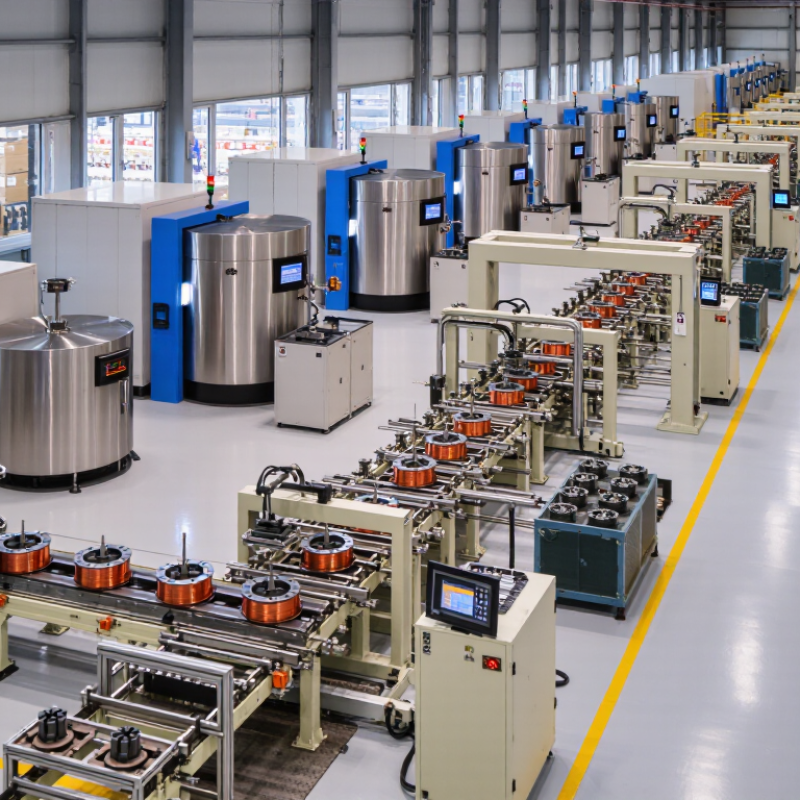
Understanding the Types of Automatic Motor Production Lines
Automatic motor production lines generally fall into three practical types: dedicated transfer lines, flexible modular lines, and hybrid systems. These are useful design categories, not a universal standard. The right choice depends on motor geometry, annual volume, and how often specifications change.
A dedicated line links processes such as shaft insertion, rotor balancing, winding, assembly, and end-of-line testing. It suits stable, high-volume products, but can be costly to reconfigure. Flexible lines use smaller stations and adjustable fixtures. They handle product changes more easily, though changeovers and manual work may reduce output. Hybrid lines combine automated bottleneck operations with adaptable workstations. Often, that is the compromise.
Look closely at the physical details. A stator with delicate slot insulation needs controlled handling; a heavy rotor may require precise balancing and guarded transfer. The International Federation of Robotics reported 541,302 industrial robot installations worldwide in 2023, in World Robotics 2024. That signals broad automation adoption, not guaranteed savings for every motor plant. The International Energy Agency’s Global EV Outlook 2024 estimated nearly 14 million electric-car sales in 2023. This growth adds pressure to scale traction-motor capacity. Still, forecasts are not purchase orders. Pilot a representative product mix, measure cycle time and defect rates, then check whether the line can absorb future design changes. A spreadsheet can miss awkward reality.
| Production Line Type | Typical Product Mix | Common Automated Operations | Best Suited For | Flexibility and Changeover | Key Selection Considerations |
|---|---|---|---|---|---|
| Dedicated transfer line | A narrow range of motor models with largely shared dimensions and process requirements. | Consecutive stations may perform component loading, shaft or bearing assembly, fastening, and in-line inspection. | Stable, high-volume production where the product design and process route are well established. | Typically lower flexibility. Model changes may require tooling, fixture, or station adjustments. | Confirm demand stability, cycle-time balance, maintenance access, and the cost of future product changes. |
| Modular indexed line | Several related motor variants that share a common assembly sequence. | Workpieces move between modular stations for operations such as rotor insertion, end-cover assembly, fastening, and testing. | Production that needs a balance between automated output and the ability to add, remove, or reconfigure stations. | Moderate flexibility. Modules and fixtures can often be adapted for approved product variants. | Check station interfaces, buffer capacity, fixture change requirements, and how easily the line can be expanded. |
| Flexible robotic line | Multiple motor sizes or variants, often with changing production schedules. | Robots may handle part loading, transfer, fastening, dispensing, or machine tending; vision systems can support part identification and orientation. | Mixed-model production where frequent product changes make fixed, model-specific automation less suitable. | Potentially higher flexibility, provided the robot reach, grippers, programs, and fixtures cover the required variants. | Assess part presentation, end-effector changes, programming needs, safety layout, and the validation required after a model change. |
| Stator winding and insertion line | Motor stators with winding layouts and slot geometries supported by the selected tooling. | Depending on the design, operations can include wire winding, coil insertion, lead forming, electrical checks, and preparation for insulation treatment. | Manufacturers seeking consistent winding and insertion processes for a defined family of stators. | Flexibility depends on winding technology, coil geometry, slot configuration, and how quickly tooling can be changed. | Specify winding method, wire dimensions, slot fill requirements, insulation system, and compatibility with downstream processes. |
| Rotor assembly and balancing line | Rotor assemblies with defined shaft, core, magnet, or component configurations. | May include component loading, shaft or magnet assembly, runout checks, dynamic balancing, and rotor inspection. | Production where rotor assembly accuracy and control of rotating-part balance are important to motor performance. | Varies with rotor design. Different configurations may require separate fixtures or balancing recipes. | Define the rotor construction, balance acceptance criteria, measurement method, traceability needs, and rework process. |
| End-of-line assembly and test line | Motors that have completed component manufacturing and require final assembly and verification. | May include bearing or end-cover installation, fastening, electrical safety testing, winding checks, no-load testing, and data recording. | Factories that need repeatable final assembly, quality checks, and documented test results before shipment. | Test programs and fixtures can support multiple models when the hardware and procedures are designed for them. | Choose tests based on product specifications and applicable requirements; plan for calibration, data storage, and failed-unit handling. |
FAQS
Dedicated lines suit stable, high-volume products. Flexible lines handle frequent model changes. Hybrid lines automate bottleneck steps and keep other stations adaptable. Often, that is the compromise.
List motor types, peak daily volume, shifts, and expected product changes. Record frame size, shaft dimensions, voltage, power, torque, and insulation needs. Small details matter.
Wire size, slot count, bearing fit, and acceptable tolerances all matter. Delicate slot insulation needs careful handling. Heavy rotors may need precise balancing and guarded transfer.
Set a target cycle time for key steps, such as winding, rotor insertion, and final testing. Run representative products through a pilot. Measure cycle time and defects, not just the projected output.
Check how it detects winding faults, weak connections, and electrical test failures. Ask whether results link to each unit’s serial number. A rejected motor should be easy to trace.
Consider how often motor sizes, winding patterns, or order volumes change. Adjustable fixtures can shorten changeovers, but add setup work. A useful feature might sit idle for months.
Include energy, consumables, maintenance hours, training, and changeover downtime. Ask about service intervals and routine replacement parts. One unavailable component can stop production.
Check operator access, maintenance clearance, sensor access, and connector orientation. Drawings may overlook awkward real-world details. I may still be missing something. A short pilot can expose gaps.
Conclusion
Choosing an Automatic Motor Production Line begins with understanding the available line types and matching them to the motors you plan to manufacture. Define your production volume, motor designs, component requirements, and expected product range before comparing equipment. These details help determine which processes should be automated and whether the line can handle the required capacity, sequence, and level of customization.
Next, assess process compatibility, quality-control systems, flexibility, and total operating costs, including labor, maintenance, and energy use. A suitable line should support consistent production while allowing practical adjustments as requirements change. Carefully evaluate potential suppliers’ technical support and project experience, then plan installation, operator training, and validation. Testing the line against clear performance and quality criteria before full-scale operation can help ensure it meets production goals and is ready for reliable, efficient use.